Marco
Marco 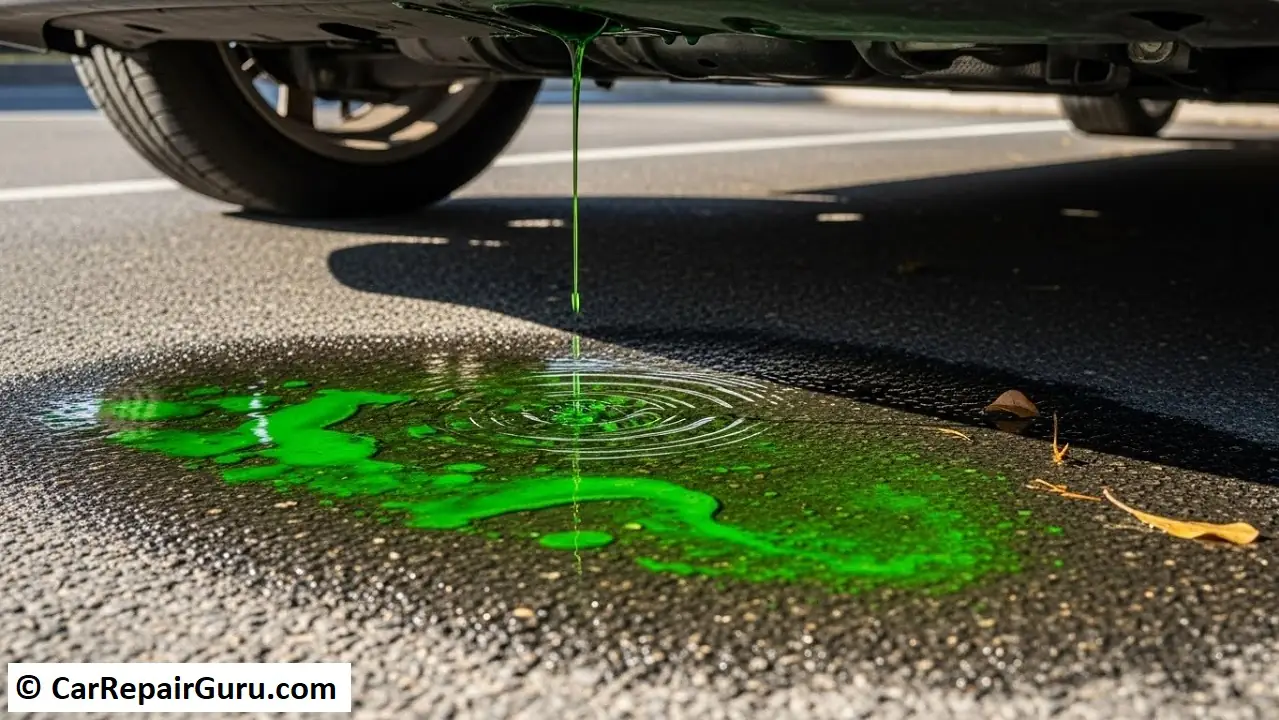
You walk out to your car in the morning and notice a vibrant, colored puddle on the pavement under the front of your engine. Your first thought might be to ignore it, but that colorful drip is your car’s way of crying for help. That puddle is likely an engine coolant leak, a problem that starts small but can quickly lead to catastrophic engine damage if left unchecked.
Ignoring an antifreeze leak is like ignoring a leaky roof—it will only get worse and more expensive over time.
In this complete guide, we’ll walk you through everything you need to know. We’ll cover the telltale symptoms, uncover the most common causes, and give you realistic repair costs. By the end, you’ll understand what’s happening in your engine and what to do about it.
- What is Engine Coolant and Why is it Essential?
- 8 Telltale Signs of an Engine Coolant Leak
- Common Causes – Where is the Coolant Coming From?
- Internal vs. External Coolant Leaks – Understanding the Severity
- External Leaks (The Common & Visible Kind)
- Internal Leaks (The Hidden & Dangerous Kind)
- How to Find a Coolant Leak – A Step-by-Step Guide
- Repair Options and Estimated Costs
- DIY Fixes (For Minor External Leaks)
- Estimated Coolant Leak Repair Costs
- Preventing Future Coolant Leaks – A Maintenance Checklist
- Is it Safe to Drive with a Coolant Leak?
- Final Thoughts – Don’t Ignore the Drip
- Frequently Asked Questions (FAQ)
- Is it a coolant leak or just water from my AC?
- Why are there so many different coolant colors?
- Do coolant stop leak products actually work?
- Can I just use water instead of coolant?
- How urgent is a small coolant leak?
What is Engine Coolant and Why is it Essential?
Think of engine coolant (also known as antifreeze) as the lifeblood of your engine’s cooling system. This brightly colored liquid is a mixture of antifreeze and water, and it has two critical jobs:
- Preventing Overheating: It circulates through your engine, absorbing excess heat and carrying it to the radiator to be dissipated.
- Preventing Freezing: In cold weather, it prevents the water in your system from freezing, expanding, and cracking your engine block or radiator.
When your coolant level drops due to a leak, your engine loses its ability to regulate its temperature. This quickly leads to overheating, which can warp critical components, blow a head gasket, and ultimately cause complete engine failure.
8 Telltale Signs of an Engine Coolant Leak
Not all leaks leave a giant puddle. Sometimes, the signs are much more subtle. If you notice any of these symptoms, your car is trying to tell you it has a coolant leak.
- The Visible Puddle: This is the most obvious sign. You’ll find a puddle of liquid under the front of your car that is typically bright green, pink, orange, or blue, depending on your vehicle’s manufacturer. It will often feel slightly slimy or oily to the touch.
- The Sweet Smell: Engine coolant has a distinct, sweet, syrupy odor. If you notice a smell like hot maple syrup or candy around your car, especially after it’s been running, you’re likely smelling burning or evaporating antifreeze.
- Overheating Engine: Your car’s temperature gauge on the dashboard should normally sit in the middle. If you see it creeping up into the red zone, it’s a major red flag that your engine isn’t being cooled properly, often due to low coolant.
- Low Coolant Warning Light: Many modern cars have a sensor that will trigger a warning light on your dashboard when the coolant level in the reservoir is too low. This is your car’s direct plea for help.
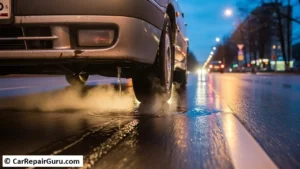
- Billowing White Smoke from the Exhaust: While a little white vapor on a cold day is normal, thick, sweet-smelling white smoke billowing from your tailpipe is a classic sign of an internal coolant leak, where coolant is being burned inside the engine.
- White, Crusty Residue: A slow leak might evaporate before it has a chance to drip. Look for white or colored crystalline stains on or around the radiator, hoses, or engine components. This is the dried residue left behind by leaking antifreeze.
- “Milky” Engine Oil: Pull out your engine’s oil dipstick. If the oil looks like a creamy coffee or a chocolate milkshake, you have a serious problem. This indicates that coolant is leaking internally and mixing with your oil, ruining its ability to lubricate the engine.
- Poor Heater Performance: Your car’s cabin heater uses hot coolant to generate warm air. If you turn on your heat and it’s blowing cool or lukewarm air, it can be a sign that there isn’t enough hot coolant circulating through the heater core.
Common Causes – Where is the Coolant Coming From?
A coolant leak can originate from several different parts of the cooling system. Here are the most common culprits, from simple fixes to major repairs.
1. Leaking Radiator and Hoses
This is the number one cause. Over time, the rubber hoses that carry coolant become brittle and crack. The radiator itself can be damaged by road debris or develop cracks in its plastic end tanks due to constant heat cycles.
The water pump is the heart of your cooling system, responsible for circulating the coolant. Its seals and gaskets can wear out over time, causing a leak. A common sign is a drip coming from the “weep hole” on the bottom of the pump.
3. Faulty Thermostat Housing
The thermostat regulates engine temperature, and it’s contained within a housing. These housings, often made of plastic, can become brittle and crack, causing a leak.
4. Cracked Coolant Reservoir/Expansion Tank
The plastic tank that holds your reserve coolant can also degrade with age and develop cracks, leading to a slow but steady leak.
5. Leaking Heater Core
Essentially a mini-radiator for your cabin, the heater core can spring a leak. This usually results in a sweet smell inside the car and a wet passenger-side floorboard.
6. Blown Head Gasket (The Serious One)
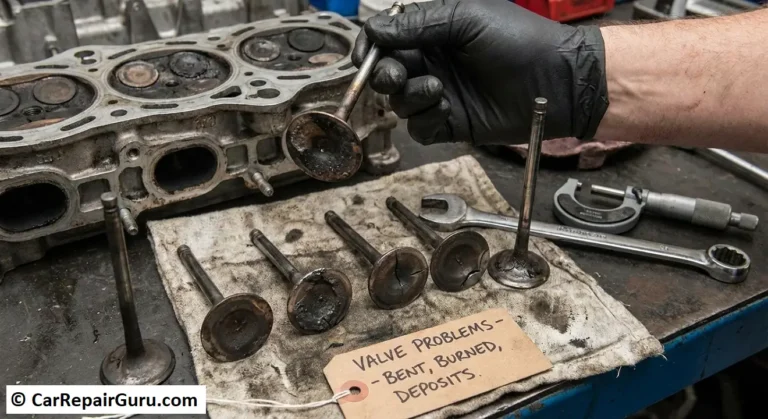
The head gasket is a crucial seal between the engine block and the cylinder head. If it fails, it can allow coolant to leak into the engine’s cylinders or mix with the oil. This is a major internal leak that requires extensive and expensive repairs.
Internal vs. External Coolant Leaks – Understanding the Severity
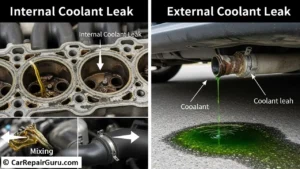
Not all leaks are created equal. Knowing the difference between an external and an internal leak is key to understanding the urgency of the situation.
External Leaks (The Common & Visible Kind)
- What they are: Coolant is leaking from a component onto the ground or other parts of the engine bay. This includes leaks from your radiator, hoses, water pump, and reservoir tank.
- Key Symptoms: Visible puddles under the car, a sweet smell outside the car, and crusty residue on engine parts.
- Severity: These are the most common leaks. If caught early, they are generally less severe and cheaper to fix.
Internal Leaks (The Hidden & Dangerous Kind)
- What they are: Coolant is leaking into the engine’s combustion chambers or oil system. This is almost always caused by a failed head gasket or, in rare cases, a cracked cylinder head or engine block.
- Key Symptoms: Billowing white smoke from the exhaust, milky engine oil, and rapid, unexplained coolant loss with no visible drip on the ground.
- Severity: This is a critical emergency. You should stop driving the vehicle immediately to prevent destroying the engine.
How to Find a Coolant Leak – A Step-by-Step Guide
Ready to play detective? Here’s how you can pinpoint the source of the leak.
SAFETY FIRST: WARNING! Never open the radiator cap or work on the cooling system when the engine is hot. The system is under pressure and can spray scalding hot coolant, causing serious burns. Always let the engine cool down completely.
1. The Visual Inspection: Start from the bottom up. Identify where the puddle is forming on the ground to get a general idea of the location. Then, open the hood and, using a flashlight, look directly above that area. Trace any wetness or staining upwards. Look for obvious drips, cracks in hoses, or crusty residue around hose clamps and gaskets.
2. The Pressure Test (The Professional Method): The most reliable way to find a leak is with a cooling system pressure tester. This tool attaches to the radiator or coolant reservoir and allows you to manually pressurize the system (while the engine is off and cool). This forces coolant out of even the smallest cracks, making the leak immediately visible. You can often rent these testers from auto parts stores.
3. Using UV Dye: For very small, “stealthy” leaks, a mechanic may add a special UV dye to the coolant. After you drive the car for a day, they will use a blacklight to inspect the engine bay. The dye will glow brightly under the UV light, revealing the exact source of the leak.
Repair Options and Estimated Costs
The cost to fix a coolant leak varies dramatically depending on what’s broken.
DIY Fixes (For Minor External Leaks)
If you’re comfortable working on your car, you can tackle some of the simpler repairs, like replacing a leaky radiator hose or tightening a loose clamp. These parts are generally inexpensive.
A Word of Caution on “Stop Leak” Products: You will see bottles of “coolant stop leak” at the auto parts store. Avoid them. These products are a temporary, unreliable patch at best. The particles they use to plug the hole can also clog your radiator, heater core, and narrow coolant passages, leading to much more expensive overheating problems down the road.
Estimated Coolant Leak Repair Costs
For most jobs, it’s best to see a professional. Here are some ballpark estimates. (Note: Costs can vary significantly based on your vehicle model and local labor rates.)
| Repair Job | Estimated Professional Cost |
|---|---|
| Hose Replacement | $150 – $300 |
| Radiator Replacement | $400 – $900+ |
| Water Pump Replacement | $500 – $1,200+ |
| Thermostat Replacement | $200 – $450 |
| Head Gasket Repair | $2,000 – $4,000+ |
Preventing Future Coolant Leaks – A Maintenance Checklist
The best repair is the one you never have to make. Proactive maintenance is your best defense.
- Check Your Coolant Level Regularly: Once a month, when the engine is cold, check the level in the coolant reservoir. It should be between the “MIN” and “MAX” lines.
- Schedule Coolant Flushes: Over time, coolant loses its anti-corrosive properties. Follow your vehicle manufacturer’s recommendation for a coolant flush, typically every 3-5 years or 30,000-50,000 miles.
- Inspect Hoses and Clamps: When you get your oil changed, do a quick visual inspection of the coolant hoses. Look for any signs of bulging, cracking, or sponginess.
- Monitor Your Temperature Gauge: Make it a habit to watch your temp gauge. If it ever reads higher than normal, it’s an early warning sign that something is wrong.
- Use the Correct Type of Coolant: Cars are picky. Using the wrong color or type of antifreeze can cause chemical reactions that corrode your cooling system from the inside out. Always check your owner’s manual.
Is it Safe to Drive with a Coolant Leak?
The short answer is no.
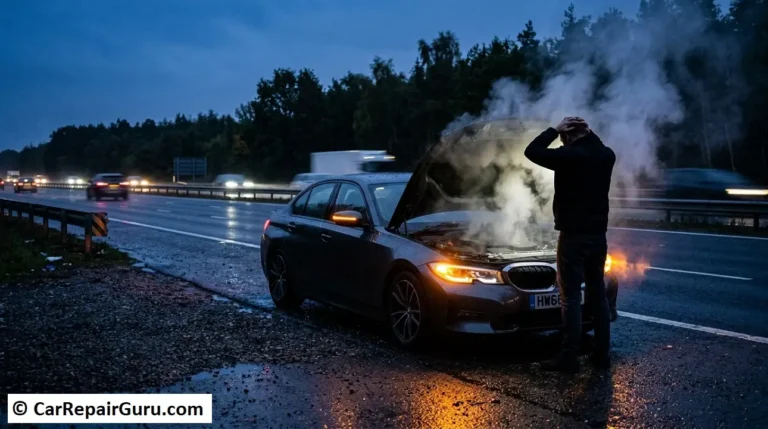
While you might be able to drive a very short distance with a tiny, slow leak while monitoring the temperature gauge, it’s a huge risk. A small leak can become a big one without warning, causing your engine to overheat in minutes. If you see the temperature gauge enter the red or get a warning light, pull over immediately and shut off the engine to prevent irreversible damage.
Final Thoughts – Don’t Ignore the Drip
That colorful puddle under your car is more than just a mess—it’s a critical warning sign from your vehicle’s cooling system. By learning to spot the symptoms and understanding the causes, you are now equipped to take action before a small drip turns into a massive repair bill.
If you’re experiencing any of these signs, don’t wait for the problem to get worse. An overheated engine is one of the most destructive and costly failures a car can suffer.
Are you concerned about a leak? Schedule a cooling system inspection with one of our expert technicians today and drive with peace of mind!
Frequently Asked Questions (FAQ)
Is it a coolant leak or just water from my AC?
Water dripping from your car is often normal condensation from the air conditioner, which is clear, odorless, and feels just like water. Coolant is brightly colored (green, pink, orange), has a distinct sweet smell, and feels slightly oily.
Why are there so many different coolant colors?
Different colors typically signify different chemical formulas designed for specific engine materials by vehicle manufacturers. The most important rule is to never mix different colors, as this can cause corrosion and damage to your cooling system.
Do coolant stop leak products actually work?
These products are a risky, temporary fix at best. While they might plug a very small hole, the particles can also clog your radiator and heater core, leading to much more severe overheating problems and expensive repairs down the road.
Can I just use water instead of coolant?
In an absolute emergency, water can get you to a safe location, but it should be replaced immediately. Water boils much faster than coolant and lacks the essential anti-freeze and anti-corrosion agents needed to protect your engine.
How urgent is a small coolant leak?
Every coolant leak should be treated as urgent. A small drip can become a major failure without warning, leaving you stranded with an overheating engine and risking thousands of dollars in damage.
About the Author