Marco Riley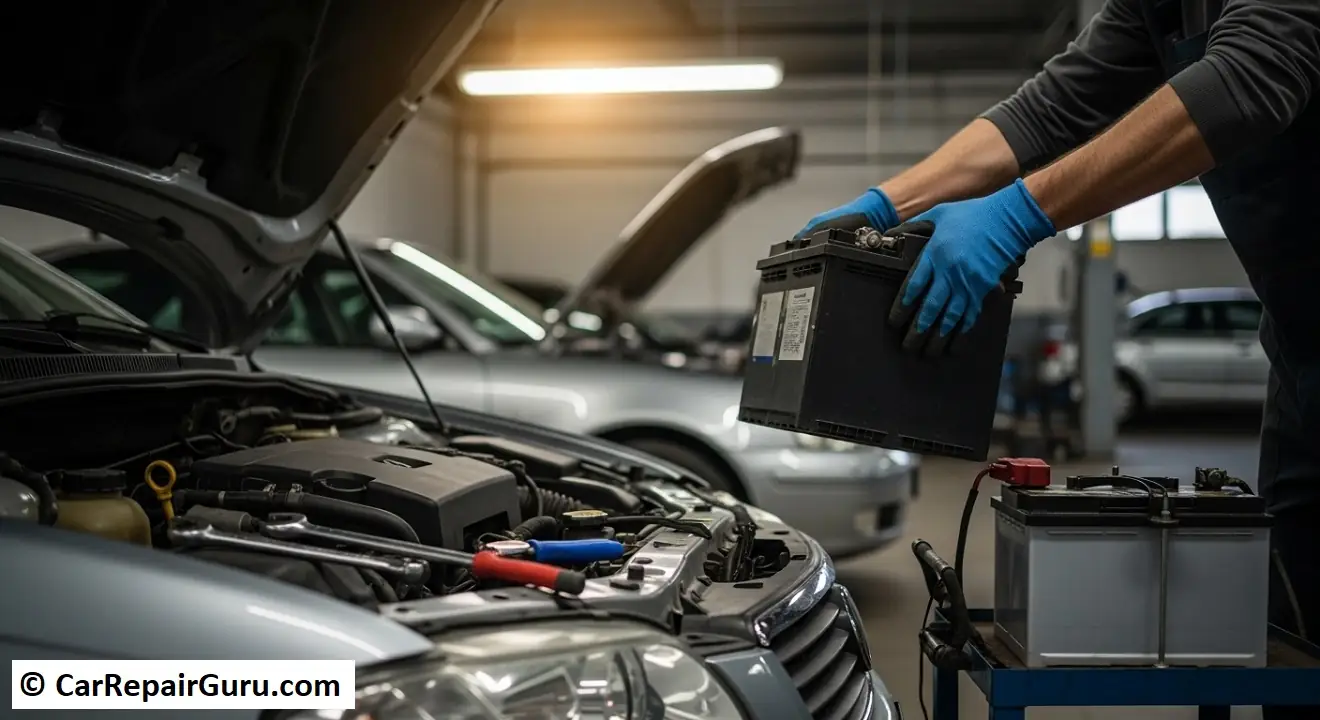
Let’s face it, there are few sounds more frustrating than the one your car makes when the battery is dead. You turn the key, and instead of the familiar roar of the engine, you get a weak clicking sound… or worse, complete silence. It’s a moment that can derail your entire day.
A dead car battery feels like a major problem, but it doesn’t have to be a major headache. Whether you’re a seasoned DIYer ready to get your hands dirty or someone who just wants to understand what you’re paying for at the shop, you’ve come to the right place.
This is your complete, no-nonsense guide to car battery replacement. We’ll walk you through everything: identifying the telltale signs of a failing battery, choosing the right replacement for your vehicle, understanding the costs involved, and providing a step-by-step tutorial for replacing it yourself.
Let’s get you powered up and back on the road with confidence.
- Is Your Car Battery Really Dead? 5 Telltale Signs You Need a Replacement
- How to Choose the Right Car Battery for Your Vehicle
- How to Replace a Car Battery Yourself (DIY Guide)
- SAFETY FIRST – A Non-Negotiable Warning
- Tools & Materials You’ll Need
- Step-by-Step Car Battery Replacement Instructions
- Professional Car Battery Replacement – When to Call the Experts
- Benefits of a Professional Service
- Where to Get Your Battery Replaced
- Understanding Car Battery Replacement Cost in
- Part 1 – The Cost of the Battery Itself
- Part 2 – Labor Costs for Installation
- Total Estimated Cost Summary
- Pro Tips to Maximize Your Car Battery’s Lifespan
- Final Thoughts – Power Up and Drive with Confidence
- Frequently Asked Questions
- How long do car batteries last?
- Can I just jump-start my car instead of replacing the battery?
- What’s the difference between a bad battery and a bad alternator?
- Do I lose my car’s memory settings when I replace the battery?
Is Your Car Battery Really Dead? 5 Telltale Signs You Need a Replacement
Before you rush out to buy a new battery, it’s important to confirm that the battery is actually the culprit. Sometimes, a problem with your car’s alternator or starter can mimic the symptoms of a dying battery. Here are the five most common signs of a bad car battery that’s ready for retirement.
- The Slow, Sluggish Engine Crank
This is the classic symptom. When you turn the ignition, the engine turns over much slower than usual, sounding labored and weak. It might sound like chug-chug-chug instead of a crisp startup. This happens because the battery no longer has enough power to turn the starter motor with the force it needs. - Warning Lights on the Dashboard
Your car is designed to tell you when something is wrong. If you see the battery symbol light up on your dashboard, it’s a direct warning that your charging system has a problem. Sometimes, the “Check Engine” light can also illuminate due to the low voltage from a failing battery. - Dim Lights and Electrical Gremlins
Your battery powers everything electrical in your vehicle. If it’s on its last legs, you’ll start to notice. Are your headlights dimmer than usual, especially when you start the car? Do your interior lights flicker or does your radio cut out? These electrical “gremlins” are a clear indicator that the battery is struggling to supply consistent power. - Visible Corrosion on the Terminals
Pop the hood and take a look at the battery itself. The metal posts where the cables connect are called terminals. If you see a white, blue, or greenish powdery substance caked around them, you have a corrosion problem. This buildup can interfere with the electrical connection, but it’s also often a sign of an old battery that is leaking gas or acid. - Old Age (The 3-to-5-Year Rule)
Car batteries are not meant to last forever. On average, a standard car battery has a lifespan of 3 to 5 years. This can be shorter in extremely hot climates (which degrades the battery faster) or longer in milder climates. Most batteries have a date code sticker on them. If yours is pushing five years old and showing any of the symptoms above, it’s likely time for a replacement before it leaves you stranded.
How to Choose the Right Car Battery for Your Vehicle
So, you’ve confirmed the battery is the problem. Now comes the next step: buying a new one. Walking into an auto parts store can be overwhelming with all the different brands, sizes, and types available. Choosing the right one is critical for your car’s performance and longevity. Here’s what you need to know.
1. Find Your Battery Group Size
This is the most important factor. The “Group Size” dictates the battery’s physical dimensions (length, width, height) and the location and polarity of its terminals (is the positive post on the left or right?). An incorrect group size simply won’t fit in the battery tray or the cables won’t reach.
- How to find it:
- Check the Old Battery: The group size is almost always printed on the label of your current battery (e.g., “Group 24F,” “H6,” or “Group 94R”).
- Consult Your Owner’s Manual: Your vehicle’s manual will specify the correct battery group size.
- Use an Online Tool: Every major auto parts store website has a “battery finder” tool where you can input your car’s year, make, and model to see compatible options.
2. Understand Cold Cranking Amps (CCA)
CCA is a rating that measures a battery’s ability to start an engine in cold weather (specifically at 0°F or -18°C). The higher the CCA number, the more starting power it has.
- Our recommendation: Your owner’s manual will list a minimum CCA requirement. You should choose a battery that meets or exceeds this number. If you live in a place with harsh winters, opting for a battery with a higher CCA is a smart investment for reliable cold-weather starts.
3. Select the Correct Battery Type – Lead-Acid vs. AGM
This is where modern car technology comes into play. There are two main types you’ll encounter:
- Standard Flooded (Lead-Acid): This is the traditional, workhorse car battery. It’s the most common and affordable type, perfectly suitable for older vehicles without advanced electronic features like automatic start-stop.
- AGM (Absorbent Glass Mat): This is a more advanced, premium battery. It’s designed to handle the heavy electrical demands of modern vehicles. If your car has an automatic start-stop feature (the engine shuts off at red lights), it almost certainly requires an AGM battery. They are also more resistant to vibration and typically last longer than standard batteries.
Crucial Tip: If your car came from the factory with an AGM battery, you must replace it with another AGM battery. Downgrading to a standard flooded battery will lead to poor performance, electrical system errors, and a very short battery life.
How to Replace a Car Battery Yourself (DIY Guide)
Ready to save some money and gain a little mechanical confidence? A DIY car battery replacement is a straightforward job that most people can handle in under an hour with just a few basic tools.
SAFETY FIRST – A Non-Negotiable Warning
Before you begin, read this. Car batteries contain corrosive sulfuric acid and can produce explosive hydrogen gas. A mistake can lead to serious injury or damage to your vehicle’s electronics.
- Always wear safety glasses and gloves.
- Work in a well-ventilated area.
- Remove all metal jewelry (rings, watches, necklaces). If a metal tool touches both the positive terminal and a grounded part of the car simultaneously, it will create a dangerous short circuit.
- Never smoke or create sparks near the battery.
Tools & Materials You’ll Need
- New Battery: The correct one for your vehicle (see the section above).
- Wrench Set or Socket Set: A 10mm wrench or socket is the most common size for battery terminals, but have a few other sizes handy (like 12mm or 13mm) for the hold-down clamp.
- Battery Terminal Cleaner Tool: A cheap but highly effective wire brush tool designed for cleaning the posts and cable clamps.
- Anti-Corrosion Spray or Grease: To protect the terminals after installation.
- Safety Glasses and Gloves.
Step-by-Step Car Battery Replacement Instructions
Step 1: Park, Turn Off, and Locate the Battery
Park on a flat, level surface and turn off the engine. Remove the key from the ignition. Open the hood and locate the battery. In most cars, it’s at the front or side of the engine bay. In some vehicles, it might be in the trunk or even under a seat (check your owner’s manual if you can’t find it).
Step 2: Disconnect the Negative (-) Terminal FIRST
This is the most important rule of battery replacement. Using your wrench (likely a 10mm), loosen the nut on the black, negative (-) terminal. You don’t need to remove the nut completely, just loosen it enough so you can wiggle the cable clamp off the battery post. Tuck the negative cable away to the side so it can’t accidentally touch the battery.
- Why negative first? Once the negative cable (the ground) is disconnected, the car’s electrical circuit is broken. This prevents you from creating a dangerous spark if your metal wrench accidentally touches a metal part of the car while you’re working on the positive terminal.
Step 3: Disconnect the Positive (+) Terminal
Now that the circuit is safe, loosen the nut on the red, positive (+) terminal. Some positive terminals have a plastic cover you’ll need to flip open first. Wiggle the positive cable clamp off the post and tuck it to the side.
Step 4: Remove the Battery Hold-Down Clamp
The battery is secured in its tray by a hold-down clamp or bracket. This might be a metal bar across the top or a small block at the base of the battery. Use your wrench or socket to loosen and remove the bolts holding it in place. Keep these parts somewhere safe.
Step 5: Carefully Lift Out the Old Battery
Car batteries are surprisingly heavy (30-50 lbs). Grab it firmly with both hands and lift it straight up and out of the tray. Be careful not to strain your back.
Step 6: Clean the Battery Tray and Terminals
Now is the perfect time for some cleaning. If there’s any corrosion or gunk in the battery tray, wipe it out. Use your battery terminal cleaning tool (or a wire brush) to scrub the inside of the cable clamps until they are shiny. A clean, bright metal surface ensures the best possible electrical connection.
Step 7: Install the New Battery
Carefully lower the new battery into the tray, making sure it’s oriented correctly with the positive (+) and negative (-) terminals on the proper sides. Re-install the hold-down clamp and tighten it until the battery is secure and doesn’t move.
Step 8: Connect the Positive (+) Terminal FIRST
When reconnecting, you do the opposite of removal. Place the red, positive (+) clamp onto the positive post and tighten the nut securely. You shouldn’t be able to wiggle it by hand.
Step 9: Connect the Negative (-) Terminal
Now, connect the black, negative (-) clamp to the negative post and tighten it down. You might see a tiny, harmless spark when you first make the connection—this is normal.
Step 10: Protect Your Terminals
Spray a thin layer of anti-corrosion spray or apply a dab of dielectric grease to both terminals. This will help prevent future corrosion from forming.
Step 11: Start Your Car!
Close the hood, get in, and start your car. It should fire right up with new life. Check that your lights, radio, and other electronics are working. Note: You may need to reset your radio presets and clock.
Step 12: Properly Dispose of the Old Battery
Do not throw your old battery in the trash! It is illegal and extremely harmful to the environment. When you buy a new battery, you pay a “core charge.” To get this charge refunded (usually $10-$20), simply bring your old battery back to the auto parts store. They will ensure it gets recycled safely.
Professional Car Battery Replacement – When to Call the Experts
The DIY approach is rewarding, but let’s be honest—it’s not for everyone. If you lack the time, the tools, or the confidence, or if you simply own a newer, more complex vehicle, opting for a professional car battery replacement is a smart, stress-free choice.
There’s no shame in leaving it to the pros. In fact, for many modern cars, it’s the recommended route. Here’s why.
Benefits of a Professional Service
- Diagnostic Testing: A key benefit of a professional service is that they can test your entire charging system. Is it really the battery, or is a failing alternator not recharging it properly? A technician can perform a quick diagnostic test to confirm the root cause, potentially saving you from buying a battery you don’t need.
- Handling Modern Car Complexity: In many cars built in the last decade, replacing the battery isn’t just a simple swap. Vehicles with sophisticated electronics and battery management systems (BMS) require the new battery to be “registered” with the car’s computer. Skipping this step can lead to overcharging, undercharging, and a drastically shortened lifespan for your brand-new battery. This is a job for a professional with the right scanning tools.
- Speed, Safety, and the Right Tools: A professional can perform a battery swap quickly and safely, often in 15-30 minutes. They have all the right tools for the job, including memory savers that plug into your car’s OBD-II port to keep your radio presets, clock, and computer settings from being erased.
- Warranty and Peace of Mind: When a shop installs your battery, you typically get a warranty on both the part and the labor. If anything goes wrong, you can take it right back to them.
Where to Get Your Battery Replaced
You have several convenient options when looking for “car battery replacement near me”:
- Auto Parts Stores: Chains like AutoZone, Advance Auto Parts, and O’Reilly often offer free battery testing and free installation with the purchase of a new battery. This is an incredibly popular and cost-effective option, but they may not be able to handle complex installations that require computer registration.
- Independent Mechanic Shops & Dealerships: Your local mechanic or dealership is fully equipped to handle any battery replacement, including those on high-end or complex vehicles. They can perform full system diagnostics and properly register the new battery with your car’s computer. This service will have a labor cost but offers the most comprehensive care.
- Mobile Battery Replacement Services: Companies like AAA or other mobile mechanics can come directly to you—at home, at work, or on the side of the road. This offers maximum convenience, especially if your car is already dead and won’t start.
Understanding Car Battery Replacement Cost in
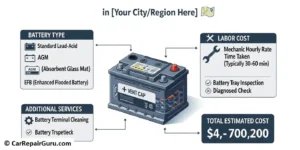
One of the biggest questions on everyone’s mind is, “How much is this going to cost?” The price of a car battery replacement can vary significantly based on three main factors: the type of battery your car needs, the cost of labor, and the brand you choose.
Let’s break it down.
Part 1 – The Cost of the Battery Itself
- Standard Lead-Acid Battery: For most older vehicles without start-stop technology, you can expect to pay between $100 and $200 for a new battery.
- AGM (Absorbent Glass Mat) Battery: If your car is newer and has features like automatic start-stop, you’ll need an AGM battery. These are more powerful and durable, and their price reflects that, typically ranging from $200 to $350 or more.
Don’t Forget the “Core Charge”: When you buy a new battery, you’ll see a separate “core charge” on the receipt, usually around $15-$25. This is essentially a deposit to encourage recycling. You get this money back in full when you return your old battery to the store.
Part 2 – Labor Costs for Installation
- DIY: $0 (Just your time and effort!)
- Auto Parts Stores: Often $0 (Free with the purchase of a battery).
- Mechanic or Dealership: Labor typically costs between $50 and $150. This fee can be higher if the battery is in a difficult-to-access location, like under the back seat, in the trunk, or inside a wheel well, which requires more time and effort to replace.
Total Estimated Cost Summary
Here’s a simple table to give you a clear idea of your all-in cost:
| Service Type | Battery Cost | Labor Cost | Total Estimated Cost |
|---|---|---|---|
| DIY | $100 – $350+ | $0 | $100 – $350+ |
| Auto Parts Store | $100 – $350+ | Often $0 | $100 – $350+ |
| Mechanic / Dealer | $100 – $350+ | $50 – $150+ | $150 – $500+ |
Pro Tips to Maximize Your Car Battery’s Lifespan
While every battery will eventually need to be replaced, you can take a few simple steps to make sure you get every last bit of life out of it. Proper car battery maintenance can help you avoid premature failure and save money in the long run.
- Keep It Clean: As we mentioned in the DIY section, corrosion is the enemy. Periodically check your battery terminals. If you see any white or blue powder, clean it off with a wire brush and a mixture of baking soda and water. A clean connection is a happy connection.
- Keep It Secure: A vibrating battery can suffer internal damage and short-circuit. Make sure your battery’s hold-down clamp is always tight and secure.
- Avoid Short Trips: Your car’s alternator recharges the battery while you drive. Frequent short trips (less than 20 minutes) don’t give the alternator enough time to fully replenish the charge used to start the engine. If you mainly take short trips, try to take your car for a longer drive (30+ minutes) at least once a week.
- Minimize Power Drain When the Engine is Off: Be mindful of using your radio, headlights, or interior lights when the engine isn’t running. And always double-check that you’ve turned everything off before leaving the car to prevent a parasitic drain.
- Test It Periodically: Once your battery is over three years old, have it tested annually. Most auto parts stores will do this for free. This gives you a heads-up on its health, so you can replace it on your schedule, not on the side of the road.
Final Thoughts – Power Up and Drive with Confidence
A dead car battery is an inconvenience, but armed with the right knowledge, it’s a problem you can solve quickly and efficiently. We’ve covered how to spot the warning signs of a failing battery, how to choose the right replacement, and how to decide between a DIY swap and a professional installation.
Whether you choose to tackle the job yourself or hand the keys to a trusted technician, a fresh, powerful battery is key to a reliable vehicle. By following the maintenance tips we’ve shared, you can extend the life of your new battery and drive with the peace of mind that your car will start every time you turn the key.
Have a question we didn’t answer or a DIY tip to share? Leave a comment below
Frequently Asked Questions
Here are quick answers to some of the most common questions about car batteries.
How long do car batteries last?
On average, a car battery lasts between 3 to 5 years. Factors like extreme heat, frequent short trips, and heavy electronic use can shorten this lifespan, while mild climates and good driving habits can extend it.
Can I just jump-start my car instead of replacing the battery?
A jump-start is a temporary solution for a battery that has been accidentally drained (e.g., you left the lights on). However, if the battery is old and can no longer hold a proper charge, a jump-start is just a band-aid. The car will likely fail to start again soon, and it’s time for a replacement.
What’s the difference between a bad battery and a bad alternator?
A bad battery won’t hold a charge, so the car won’t start. A bad alternator won’t charge the battery, so the car might start with a jump but will die while it’s running once the initial battery power is used up. A dimming of all lights while the car is running is a classic sign of a failing alternator.
Do I lose my car’s memory settings when I replace the battery?
Yes, in most cases, disconnecting the battery will reset your radio presets, clock, and sometimes the car’s computer settings. Professionals use a “memory saver” device to prevent this. For a DIY replacement, you can either accept the reset or purchase an inexpensive memory saver that plugs into your car’s OBD-II port.
About the Author