Marco Riley
Ever get that sinking feeling? You press the brake pedal, and something just feels… off. Maybe it’s a new, high-pitched squeal or a strange vibration through the steering wheel. Your car’s brake system is, without a doubt, its most critical safety feature. Ignoring the early warning signs is a risk no one should take.
The good news is you don’t have to be a master mechanic to stay ahead of potential problems. A regular car brake safety check is something anyone can do. This guide will walk you through everything you need to know to listen to your car, understand what it’s telling you, and confidently check your car’s brake system for safety.
Key Times to Perform a Brake Safety Check
Routine checks prevent roadside emergencies. Make it a habit to inspect your brakes at these key moments:
- Routinely: Every time you get your oil changed, or at least every six months.
- Seasonally: Before a long summer road trip or before winter brings icy conditions.
- Immediately: If you notice any of the warning signs we’re about to cover.
- Key Times to Perform a Brake Safety Check
- Understanding the Key Components of Your Brake System
- Step 1 – The Sensory Check – What to Listen and Feel For
- Listen for Telltale Brake Noises
- Feel for Changes in Performance
- Step 2 – The Visual Inspection – What to Look For
- Check Your Dashboard’s Brake Warning Light
- How to Check Your Brake Fluid
- Inspect the Brake Pads and Rotors (If Possible)
- Beyond the Basics – Modern Brake System Features
- Tips to Extend the Life of Your Brakes
- Red Flags – When to See a Mechanic Immediately
- What to Expect During a Professional Brake Inspection
- Be Proactive – Your Safety Depends on It
- Common Questions About Your Car’s Brake System
Understanding the Key Components of Your Brake System
Before you can diagnose a problem, it helps to know what you’re looking at. Think of your car’s brakes like the hand brakes on a bicycle, just much more powerful. Here are the four main players in this system:
- Brake Pads: These are the friction-heavy components that do the hard work. They are housed in the calipers and clamp down on the rotors to create the friction that stops your car.
- Brake Rotors (or Discs): These are the large, shiny metal discs you can often see behind the spokes of your wheels. The brake pads squeeze against the rotors to slow the wheel’s rotation.
- Brake Calipers: These are the hydraulic clamps that hold the brake pads. When you press the brake pedal, the caliper pushes the pads against the rotor.
- Brake Fluid: This is the hydraulic fluid that transfers the force from your foot on the pedal all the way to the calipers. Without it, the system has no power.
Step 1 – The Sensory Check – What to Listen and Feel For
The easiest brake system inspection starts the moment you get in the car. Your senses of hearing and touch are powerful diagnostic tools.
Listen for Telltale Brake Noises
Strange sounds are your brakes’ way of asking for help. Don’t turn up the radio—listen closely.
- A High-Pitched Squeal or Screech: This is often the first sign of bad brakes. Most brake pads have a small metal tab called a wear indicator. When the pad material wears down to a certain point, this tab scrapes against the rotor, creating that annoying squeal. It’s your car’s built-in alarm system telling you it’s time for new pads.
- A Deep, Harsh Grinding Sound: This is a critical warning. A grinding brake noise means the brake pads have worn away completely. You are now hearing metal-on-metal—the brake caliper grinding against the rotor. This not only destroys your rotors (a more expensive fix) but also severely compromises your stopping power. If you hear this, stop driving as soon as it is safe and call for service.
- Clicking: A clicking sound when you press or release the brake pedal can sometimes indicate that the brake pads are loose or the hardware holding them is worn.
Feel for Changes in Performance
How your car behaves when you brake is just as important as how it sounds.
- A Spongy or Soft Brake Pedal: Does your brake pedal feel mushy or go down much further than it used to? This classic spongy brake pedal feeling often means there is air or moisture in the brake lines, which is a serious safety issue. You may need to bleed your brakes to restore pressure. It could also point to a problem with the master cylinder.
- Vibrating or Pulsating: If you feel a shudder or vibration through the brake pedal or the steering wheel when you apply the brakes, it’s a strong indicator that your brake rotors are warped. Overheating from heavy use can cause the flat metal of the rotor to become uneven, leading to this pulsating sensation.
- Car Pulling to One Side: When you brake on a straight, flat road, does your car try to steer left or right? This is often a sign of a stuck brake caliper. One of your brakes is working harder than the other, creating an uneven force that pulls your car to one side.
- A Hard or Stiff Pedal: If you have to practically stand on the brake pedal to get the car to slow down, you may have an issue with your brake booster, which provides power assistance to the system.
Step 2 – The Visual Inspection – What to Look For
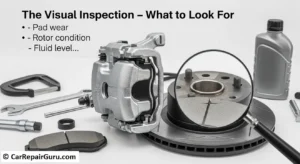
With the car parked on a level surface (and completely cool!), you can perform a few simple visual checks.
Check Your Dashboard’s Brake Warning Light
Your dashboard is your car’s communication hub. A brake warning light should never be ignored.
- The “BRAKE” or “(!)” Light: This light can mean a few things. First, check if your parking brake is engaged. If it’s off and the light is still on, it almost always indicates a serious problem, such as a drop in hydraulic pressure or dangerously low brake fluid.
- The “ABS” Light: This light indicates a problem with your Anti-lock Braking System. While your primary brakes will still work, the anti-lock safety feature will not function in an emergency stop.
How to Check Your Brake Fluid
Checking your brake fluid is quick, easy, and provides a wealth of information.
- Locate the Reservoir: Open the hood and look for a small, translucent plastic container near the back of the engine bay, on the driver’s side. The cap will usually have a brake symbol on it.
- Check the Fluid Level: The reservoir will have “MIN” (minimum) and “MAX” (maximum) lines on the side. The fluid should be between these two marks.
- Observe the Color: Healthy brake fluid is clear or has a light amber tint. If your brake fluid is dark brown or black, it has absorbed moisture and contaminants and needs to be flushed and replaced.
Inspect the Brake Pads and Rotors (If Possible)
You can often get a decent look at your brake components through the spokes of your wheels. You may need a flashlight.
- Brake Pad Thickness: Look at the brake caliper clamped over the rotor. You should be able to see the brake pad pressed against the rotor. You’re looking for the thickness of the friction material. As a rule of thumb, it should be at least a quarter-inch (about the thickness of a new pencil).
- Rotor Surface: Look at the shiny surface of the rotor. It should be relatively smooth. If you see deep grooves or scoring, it’s a sign that the rotors need to be resurfaced or replaced.
Beyond the Basics – Modern Brake System Features
The core job of your brakes hasn’t changed, but modern technology has added layers of safety and efficiency that you should be aware of. These systems work with your main brakes and can sometimes produce feelings or sounds that are perfectly normal.
- Anti-lock Braking System (ABS): This is the system that prevents your wheels from locking up and skidding during a panic stop. When it activates, you will feel a rapid pulsing in the brake pedal and may hear a buzzing or clicking sound. This is normal! It means the system is working to help you maintain steering control. Don’t pump the brakes; maintain firm pressure and steer.
- Traction and Stability Control: These safety systems use the ABS to apply individual brakes automatically to prevent wheel spin (traction control) or to keep the car from sliding sideways in a turn (stability control). You may feel or hear the system working during slippery conditions.
- Regenerative Braking (Hybrids and EVs): If you drive a hybrid or electric vehicle, your car uses its electric motor to do a lot of the slowing down. This process, called regenerative braking, recharges the battery. Because the traditional friction brakes are used less often, the pads and rotors can last much longer. This can also make the brake pedal feel slightly different from a non-hybrid car, which is normal.
Tips to Extend the Life of Your Brakes
The best way to handle brake problems is to prevent them. These brake maintenance tips can save you money and keep you safer.
- Practice Smooth Driving Habits: Constant hard braking and tailgating put immense stress and heat on your brakes, wearing them out faster. By keeping a safe following distance and anticipating stops, you can brake more gently.
- Lighten Your Load: The heavier your car is, the more energy it takes to stop. Avoid carrying unnecessary heavy items in your vehicle to reduce strain on the entire brake system.
- Adhere to Your Brake Fluid Flush Schedule: Brake fluid is hygroscopic, meaning it absorbs moisture from the air. This moisture can cause internal corrosion and lowers the fluid’s boiling point, reducing performance. Check your owner’s manual, but a fluid flush is typically recommended every 2-3 years.
- Use Engine Braking on Long Downgrades: When driving down a long, steep hill, shift your automatic transmission into a lower gear (L, 2, or 3) or downshift in a manual. This uses the engine’s resistance to help slow the car, preventing your brakes from overheating.
Red Flags – When to See a Mechanic Immediately
While many signs are early warnings, some indicate a critical failure. If you experience any of the following, pull over safely and call a tow truck. Do not continue driving.
- A loud, metallic grinding sound.
- Your “BRAKE” warning light stays on.
- You see a puddle of oily fluid near one of your wheels (a brake fluid leak).
- Your brake pedal feels spongy and goes all the way to the floor.
- You smell a chemical or burning odor after repeated braking.
What to Expect During a Professional Brake Inspection
So, you’ve identified a problem and decided to take your car to a professional. Knowing what to expect can make you a more confident and informed customer. A thorough professional brake inspection should include:
- A Conversation and Test Drive: The technician should listen to your description of the problem (the sounds, feelings, and when they happen) and may take the car for a short test drive to experience it firsthand.
- Wheels-Off Inspection: The vehicle will be put on a lift, and all four wheels will be removed. This is the only way to get a complete view of the entire system.
- Measurement and Analysis: The technician will use specialized tools, like a micrometer, to measure the exact thickness of your brake pads and rotors. They will compare these measurements to the manufacturer’s minimum safety specifications.
- Component Check: They will inspect the brake calipers for leaks or sticking pistons, check the brake hoses for cracks or brittleness, and look for any signs of brake fluid leaks throughout the system.
- A Detailed Report: Finally, you should receive a clear explanation of their findings. This should include the remaining life of your pads and rotors (often as a percentage), a description of any necessary repairs, and a detailed estimate of the costs for parts and labor before any work begins.
Be Proactive – Your Safety Depends on It
Your ability to stop is not negotiable. By learning to listen, feel, and look for the common signs of bad brakes, you are taking control of your safety. Performing a regular, quick check on your car’s brake system is one of the most empowering things you can do as a car owner.
If you notice any of these signs or are ever in doubt, don’t hesitate to have your brakes inspected by a certified mechanic. It’s a small price to pay for peace of mind on the road.
Common Questions About Your Car’s Brake System
How often should I replace my brake pads?
This varies wildly depending on your car, your pads, and your driving style. The average lifespan is between 30,000 and 70,000 miles. The best approach is to have them inspected at every oil change.
What’s the difference between brake pads and rotors?
Pads provide the friction, and rotors are the discs they squeeze. Pads are a consumable item designed to be replaced, while rotors last much longer but can be damaged by worn-out pads.
Can I just top off my brake fluid if it’s low?
While you can, low brake fluid is a symptom of a larger issue. As brake pads wear down, the calipers extend further, causing the fluid level in the reservoir to drop naturally. However, it can also signal a leak in the system. Topping it off without a proper brake system inspection is just masking a potential problem.
About the Author