Marco
Marco 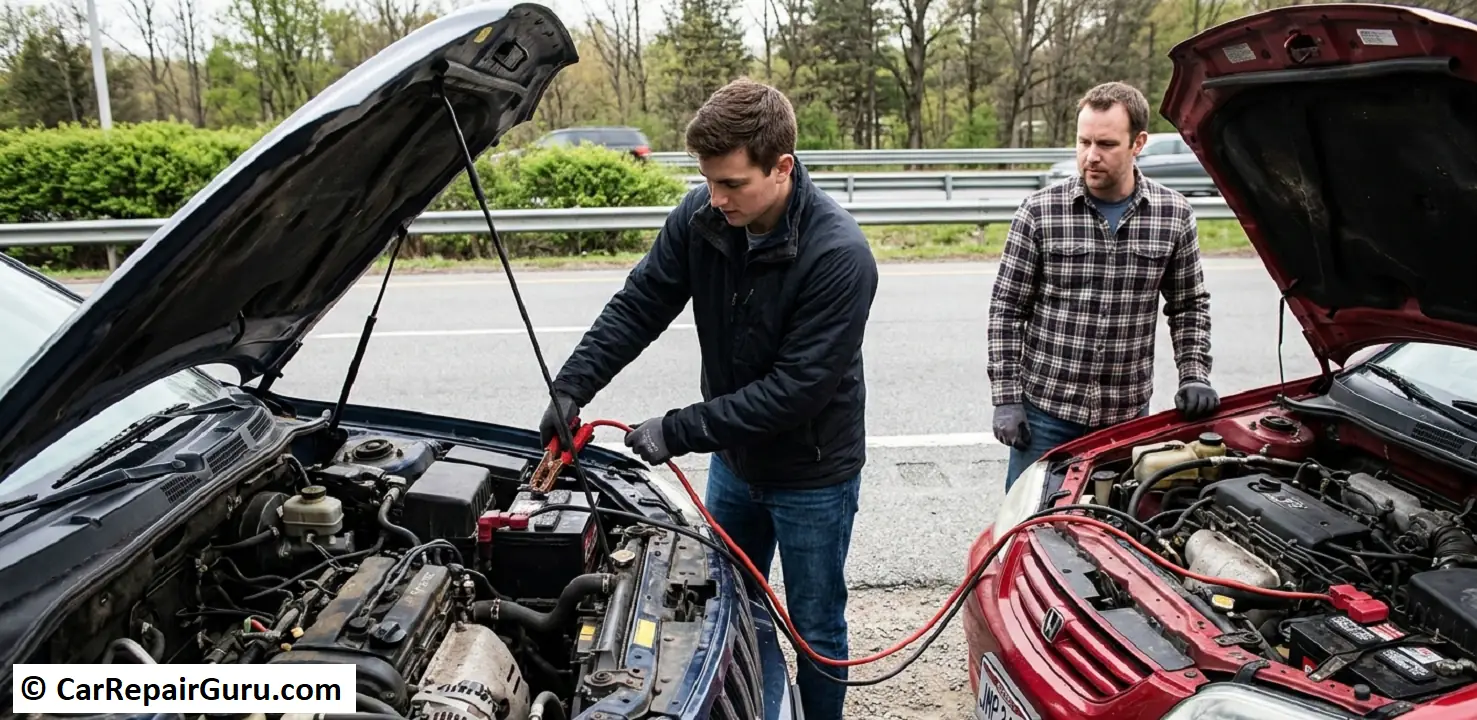
There are few sounds more disheartening to a driver than the weak click-click-click of a car that won’t start. That dreaded silence where a healthy roar should be is a universal sign of a dead car battery. It’s frustrating, inconvenient, and always seems to happen at the worst possible moment.
But here’s the good news: getting your car running again is a skill every driver can—and should—master. Whether your battery gave up because you left the lights on, it’s feeling the strain of extreme weather, or it’s simply getting old, a jump start is often all you need.
This guide will walk you through everything you need to know to safely jump start a car battery. We’ll cover the classic method with jumper cables and another vehicle, as well as the modern approach using a portable jump starter. Let’s get you back on the road.
- Before You Begin – Safety is Non-Negotiable
- Gather Your Equipment
- Critical Safety Precautions
- Method 1 – How to Jump Start a Car with Another Vehicle
- Step-by-Step Instructions
- Method 2 – How to Jump Start a Car with a Portable Jump Starter
- A Modern and Simple Solution
- What to Do After a Successful Jump Start
- Let Your Car’s Alternator Do Its Job
- Diagnose the Underlying Problem
- Final Thoughts – You’re in Control
- Troubleshooting & Frequently Asked Questions (FAQ)
- What if my car still won’t start after a jump?
- Can you damage a car by jump starting it incorrectly?
- Is it safe to jump start a car in the rain?
- How do I jump start a hybrid or a car with a start-stop system?
Before You Begin – Safety is Non-Negotiable
Before you even think about connecting any cables, taking a moment to prepare is the most important step. A car battery contains sulfuric acid and can release flammable hydrogen gas. Doing this process correctly is simple and safe, but doing it wrong can damage your car’s electronics or even cause injury. Let’s get it right.
Gather Your Equipment
You’ll need one of two setups:
- The Traditional Method:
- Jumper Cables: Don’t skimp here. A good set of thick-gauge (lower gauge number is better, like 4 or 6) and long cables is a wise investment.
- A “Donor” Vehicle: A running car with a healthy, compatible battery (most 12-volt batteries are compatible).
- The Modern Method:
- A Portable Jump Starter (or Jump Pack): These compact, powerful battery packs are fantastic to keep in your trunk and don’t require a second car.
- For Both Methods:
- Safety Gear: A pair of gloves and safety glasses are highly recommended.
- Your Car’s Owner’s Manual: It can have specific instructions or jump-starting points, especially for modern or hybrid vehicles.
Critical Safety Precautions
Read through these rules before you start. They are the key to a safe and successful jump start.
- Turn Everything Off: Ensure both cars are turned off, in Park or Neutral, with the parking brakes fully engaged. Remove the keys from the ignition.
- No Touching: The two vehicles must not be touching each other.
- Keep Clamps Apart: Never, ever let the metal clamps on the jumper cables touch each other once they are connected to a battery. This will create a dangerous spark.
- Ventilate: Work in an open, well-ventilated area.
- Inspect the Battery: If you see any cracks, leaks, or heavy corrosion on the dead battery, do not attempt to jump start it. A damaged battery can be a serious hazard. Call for professional help.
Method 1 – How to Jump Start a Car with Another Vehicle
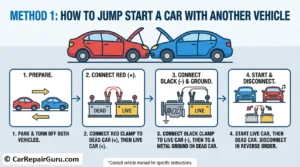
This is the classic, tried-and-true method. We’ll break it down into simple, memorable steps. Remember this simple phrase: Red to Dead, Red to Good, Black to Good, Black to Ground.
Step-by-Step Instructions
- Position the Vehicles: Park the donor car (the one that runs) close enough for the jumper cables to reach, either nose-to-nose or side-by-side. Make sure the vehicles are not touching. Pop the hood on both cars and secure them.
- Identify the Battery Terminals: Locate the batteries. You’ll see two posts or terminals. One will be marked with a plus sign (+) for positive, and the other with a minus sign (-) for negative. The positive terminal often has a red plastic cover.
- Connect the RED (Positive) Cable:
- Take one of the RED clamps and securely attach it to the POSITIVE (+) terminal of the DEAD battery.
- Take the other RED clamp and attach it to the POSITIVE (+) terminal of the DONOR (good) battery.
- Connect the BLACK (Negative) Cable:
- Take one of the BLACK clamps and attach it to the NEGATIVE (-) terminal of the DONOR (good) battery.
- THIS IS THE MOST IMPORTANT STEP: Take the final BLACK clamp and attach it to an UNPAINTED METAL SURFACE on the car with the DEAD battery. A thick, unpainted bolt on the engine block or the vehicle’s frame is a perfect spot. This is called a “ground.”
- Why do we do this? This step prevents any potential sparks from occurring directly over the battery, which could ignite those flammable gases we mentioned.
- Start the Cars:
- Start the engine of the DONOR vehicle and let it run for 2-3 minutes. This sends a charge to the dead battery.
- Now, try to start the car with the DEAD battery. If it starts, great! If it just clicks or turns over slowly, wait another few minutes with the donor car running before trying again.
- Disconnect the Cables (In the Exact Reverse Order):
Once the dead car is running smoothly, you can remove the cables. It’s crucial to do this in the opposite order you connected them to prevent sparks.- Remove the BLACK clamp from the GROUND on the formerly dead car.
- Remove the BLACK clamp from the NEGATIVE (-) terminal of the donor car.
- Remove the RED clamp from the POSITIVE (+) terminal of the donor car.
- Remove the RED clamp from the POSITIVE (+) terminal of the formerly dead car.
Be careful not to let any of the clamps touch metal parts of the car while you disconnect them.
Method 2 – How to Jump Start a Car with a Portable Jump Starter
Using a portable jump pack is faster, more convenient, and removes the need for a second car. While every model is slightly different, the general process is universal.
A Modern and Simple Solution
- Check the Jump Starter: Make sure your jump pack is charged. Most have indicator lights to show the power level.
- Turn Off Your Car: Ensure everything in your car is off, including headlights, radio, and A/C.
- Connect the Clamps:
- Attach the RED clamp from the jump starter to the POSITIVE (+) terminal of your dead battery.
- Attach the BLACK clamp to the NEGATIVE (-) terminal of your battery. (Unlike with jumper cables, connecting directly to the negative terminal is usually the recommended method for jump packs, but always double-check your device’s manual).
- Turn On the Jump Starter: Power on the device. Many have a “boost” button or will show a green light when the connection is correct and ready.
- Start Your Car: Get in your car and try to start the engine. It should turn over right away.
- Disconnect: Once your car is running, turn off the jump starter first. Then, remove the clamps in the reverse order: black first, then red.
What to Do After a Successful Jump Start
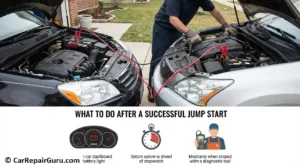
You did it! But you’re not quite finished yet.
Let Your Car’s Alternator Do Its Job
Your car’s battery is not fully charged. The jump start was just enough to get the engine running. Now, your car’s alternator needs to take over and recharge the battery.
You must keep the car running for at least 15-20 minutes. The best way to do this is to go for a drive. City driving with lots of starting and stopping isn’t as effective as a steady drive on a highway or main road.
Diagnose the Underlying Problem
A jump start is a solution, not a cure. You need to figure out why the battery died.
- Simple Mistake? Did you leave an interior light on or your headlights on? If so, you might be fine.
- A Deeper Issue? If you can’t think of a reason for the battery to be dead, it’s likely a sign of a failing battery or a problem with your car’s charging system (the alternator). Most auto parts stores offer free battery and alternator testing. It’s worth getting it checked to avoid getting stranded again.
Final Thoughts – You’re in Control
A dead battery doesn’t have to ruin your day. By understanding the proper, safe procedure for jump-starting a car, you have the knowledge to handle one of the most common roadside issues with confidence. Remember to prioritize safety, follow the steps precisely, and don’t forget to investigate the root cause afterward.
Have you ever had to jump-start your car in a tricky situation? Share your story or ask any questions in the comments below
Troubleshooting & Frequently Asked Questions (FAQ)
What if my car still won’t start after a jump?
If the engine cranks but won’t start, or you still just get a click, the battery may not be the issue. Other potential culprits include:
- A faulty alternator that isn’t charging the battery.
- Corroded or dirty battery terminals preventing a good connection.
- A bad starter motor or a blown fuse.
- A deeper electrical issue.
Can you damage a car by jump starting it incorrectly?
Yes. Connecting the cables to the wrong terminals (reverse polarity) can cause a massive electrical surge, potentially frying the car’s sensitive computer (ECU), blowing fuses, and damaging the electrical systems of both vehicles. This is why following the steps precisely is so important.
Is it safe to jump start a car in the rain?
You can, but you must be extra cautious. Water is a conductor of electricity. Try to keep the cable connections and the top of the batteries as dry as possible. If it’s a torrential downpour, it may be safer to wait or call for professional roadside assistance.
How do I jump start a hybrid or a car with a start-stop system?
Always check the owner’s manual first. Many modern and hybrid vehicles have specific jump-starting procedures or dedicated terminals under the hood (which may be far from the actual battery). Using the wrong connection point can cause serious damage.
About the Author