Marco Riley
That dreaded amber glow on your dashboard: the ABS light. It’s a common sight that can cause instant anxiety, but what does it actually mean? And more importantly, how can you figure out the problem without immediately handing over your wallet to a mechanic?
You’ve come to the right place. The Anti-lock Braking System (ABS) is a critical safety feature that keeps you in control during a panic stop. Ignoring its warning light isn’t an option. This guide will walk you through everything you need to know, empowering you to test, diagnose, and understand your car’s ABS system like a pro.
Whether you’re a complete beginner or a seasoned DIYer, we’ll give you the confidence to tackle the issue
- What is an ABS System and How Does it Work?
- 5 Telltale Signs of a Failing ABS System
- The Most Common Causes of ABS Failure
- Tools and Equipment You’ll Need for ABS Testing
- How to Test Your ABS System – 3 Essential Methods
- Method 1 – The Simple “Hard Brake” Test (Beginner Level)
- Method 2 – The Diagnostic Scan Tool Test (Intermediate Level)
- Method 3 – Testing Individual Components (Advanced DIY)
- Common ABS Trouble Codes and What They Mean
- DIY vs. Professional – When to Call a Mechanic
- Final Thoughts – Putting Brake Safety First
- Frequently Asked Questions (FAQ)
- Is it safe to drive with the ABS light on?
- How much does it cost to fix an ABS system?
- Can a bad battery or low voltage cause the ABS light to come on?
- How do I reset the ABS light?
What is an ABS System and How Does it Work?
Before we dive into testing, let’s quickly cover what this system actually does. Think of your ABS system as a smart co-pilot for your brakes. Its one and only job is to prevent your wheels from locking up and skidding during hard braking. When a wheel locks, you lose steering control. By preventing this, the Anti-lock Braking System (ABS) allows you to steer around an obstacle even while slamming on the brakes.
To do its job, the system relies on a few key components working together in fractions of a second:
- Wheel Speed Sensors: These are the “eyes” of the system. There’s one at each wheel, constantly monitoring how fast it’s spinning and sending that data to the brain.
- ABS Module/Control Unit: This is the “brain.” It’s a small computer that constantly analyzes the data from all four wheel speed sensors. If it detects one wheel is slowing down significantly faster than the others (a sign it’s about to lock up), it springs into action.
- Hydraulic Pump/Modulator: This is the “muscle.” When the brain gives the command, this unit rapidly pumps the brakes on the affected wheel—far faster than any human could—to keep it from skidding while still providing maximum braking force.
- ABS Warning Light: This is your car’s way of telling you, “Hey, there’s a problem with my safety system.”
5 Telltale Signs of a Failing ABS System
While the warning light is the most obvious clue, other symptoms can point to a problem. If you notice any of these, it’s time to investigate.
- The ABS Warning Light is On: This is the system’s built-in self-diagnostic. When the ABS module detects a fault in any of its components, it illuminates this light and stores a trouble code.
- Brakes Locking Up: If you have to brake hard and you feel your wheels skid, the ABS system is not engaging. You’ll feel the car slide uncontrollably instead of coming to a controlled stop.
- Unresponsive or Spongy Brake Pedal: Sometimes, a failure within the ABS hydraulic unit can introduce air into the brake lines or cause internal leaks, leading to a brake pedal that feels soft or sinks to the floor.
- Strange Noises or Pulsating: You should feel a pulsation in the brake pedal during a panic stop—that’s the system working. However, if you feel a random pulsing or hear grinding noises from the pump during normal, gentle braking, it could signal a malfunction.
- Traction Control or Stability Control Lights are On: Modern cars integrate these safety systems. Since traction and stability control also rely on the wheel speed sensors, a single faulty sensor can disable all three systems at once.
The Most Common Causes of ABS Failure
So, why does the ABS light come on? While it could be a complex issue, the vast majority of problems stem from a few common culprits. Understanding these will help you narrow down your search.
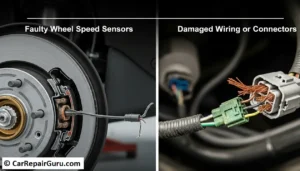
- Faulty Wheel Speed Sensors: This is, by far, the number one cause. These sensors live a hard life near the wheels, exposed to water, salt, mud, and road debris. They can get caked with metallic dust, their wiring can fray, or they can simply fail internally.
- Damaged Wiring or Connectors: Sometimes the sensor is perfectly fine, but the wire connecting it to the ABS module is broken, or the connector is corroded and can’t send a clean signal.
- Blown Fuse or Bad Relay: Before you panic, always check the simple stuff! The entire ABS system is protected by a fuse (and sometimes a relay). If it blows, the system goes dark.
- Low Brake Fluid Level: The ABS module is connected to the master cylinder. If your brake fluid is dangerously low, it can trigger the ABS light as a safety precaution.
- Failed ABS Module or Pump: This is the least common and most expensive cause. The electronic “brain” or the hydraulic “muscle” can fail, but you should always rule out every other possibility before suspecting this component.
Tools and Equipment You’ll Need for ABS Testing
Before you get your hands dirty, let’s gather the right equipment. Having these tools ready will make testing your ABS system much safer and more efficient.
Essential Diagnostic Tool:
- ABS-Compatible OBD2 Scanner: This is the most important tool you can own for this job. A standard, cheap code reader can only read engine codes (P-codes). Your ABS system stores chassis codes (C-codes). You need a scanner that can specifically read ABS/SRS/Chassis codes. It is the fastest and most accurate way to check your ABS system.
For Manual/Physical Testing:
- Digital Multimeter: This is essential for performing a wheel speed sensor test and checking for electrical continuity.
- Jack and Jack Stands: You can’t safely access the wheel speed sensors without lifting the vehicle. Never work under a car supported only by a jack.
- Basic Hand Tools: A good socket set, wrenches, and a wire brush for cleaning dirt and corrosion off components and connectors.
Safety First:
- Safety Glasses and Gloves: Your eyes and hands are irreplaceable. Protect them.
How to Test Your ABS System – 3 Essential Methods
Now for the main event. We’ll start with the simplest test and move to the most definitive.
Method 1 – The Simple “Hard Brake” Test (Beginner Level)
This test requires no tools and can give you a basic idea of whether your ABS is functional.
!! SAFETY WARNING !! This test must be performed in a large, empty, and safe location like an unused parking lot. Ensure there is no traffic, pedestrians, or obstacles nearby.
- Find Your Safe Space: Drive to your chosen safe area.
- Get Up to Speed: Accelerate to a low, safe speed—around 15-20 mph (25-30 km/h) is plenty.
- Brake Hard: In one firm, decisive motion, press the brake pedal down hard. Don’t be timid; you want to simulate a panic stop.
- Feel and Listen:
- A Working System: You will feel a rapid, rhythmic pulsing or vibration coming up through the brake pedal. You may also hear a buzzing or grinding sound. This is the hydraulic pump modulating the brake pressure, and it’s completely normal.
- A Non-Working System: The wheels will lock up completely. You’ll hear the tires screech, and the car will likely skid forward without any steering control.
This test is a simple pass/fail. If the wheels lock up, the ABS is not engaging, confirming the warning light is accurate.
Method 2 – The Diagnostic Scan Tool Test (Intermediate Level)
This is the most accurate and recommended way to start your diagnosis. An ABS scanner talks directly to the system’s “brain” and asks it, “What’s wrong?”
- Locate the OBD2 Port: Find the port, which is usually located under the driver’s side dashboard, near the steering column.
- Plug In the Scanner: Connect your ABS-compatible scanner to the port.
- Power Up: Turn your car’s ignition to the “On” position, but do not start the engine. The scanner should power on automatically.
- Scan for Codes: Follow the on-screen menu to navigate to the ABS (or Chassis) diagnostic section. Initiate a scan.
- Read the Codes: The scanner will display one or more trouble codes. The code itself is your golden ticket. For example, a code like “C0035” is far more helpful than just a light on the dash. A quick search for that code will tell you the problem is with the “Left Front Wheel Speed Sensor Circuit.” This immediately tells you which corner of the car to investigate.
Method 3 – Testing Individual Components (Advanced DIY)
Once your scanner has pointed you in the right direction (e.g., a specific wheel speed sensor), you can perform a manual ABS sensor test to confirm the failure.
How to Test an ABS Wheel Speed Sensor
- Safety First: Jack up the car and secure it on jack stands. Remove the wheel where the suspected faulty sensor is located.
- Visual Inspection: Before grabbing any tools, just look. Follow the wire from the back of the wheel hub. Is the wire frayed, melted, or chewed through? Is the connector full of green corrosion? Is the sensor tip covered in thick, greasy metal shavings? Sometimes the fix is as simple as cleaning the sensor head or its corresponding tone ring.
- Test with a Multimeter: Disconnect the sensor’s electrical connector. Now you can perform two tests:
- Resistance Test: Set your multimeter to Ohms (Ω). Touch the probes to the two pins on the sensor side of the connector. You should get a resistance reading. The exact value varies wildly by car model (anywhere from 800 to 2,500 Ohms is common), so you’ll need a repair manual for your specific vehicle to know the correct spec. If you get an open circuit (OL) or zero resistance, the sensor is bad.
- AC Voltage Test (for passive sensors): Set your multimeter to AC Volts (V~). Reconnect the sensor. Carefully back-probe the connector with your multimeter leads. Now, have a helper spin the wheel hub by hand. As the wheel spins, the sensor should generate a small AC voltage that increases with speed. If you see no voltage, the sensor is likely dead.
Checking the ABS Fuses and Module Connections
This is a simple but vital step. Your owner’s manual will show you where the ABS fuse is located (there may be more than one!). Pull it out and visually inspect it. If the metal strip inside is broken, replace it with a new fuse of the exact same amperage. Also, locate the main wiring harness on the ABS module itself and ensure it’s securely clicked in and free of corrosion.
Common ABS Trouble Codes and What They Mean
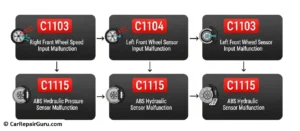
Your scanner will give you a code. Here’s a quick cheat sheet for what some of the most common ones mean:
| Code Range | Common Meaning | Example and What to Check |
|---|---|---|
| C0035 – C0050 | Wheel Speed Sensor Faults | C0040: Right Front Wheel Speed Sensor. Check the sensor, wiring, and tone ring on that specific wheel. |
| C0110 – C0115 | Hydraulic Pump Motor Faults | C0110: Pump Motor Circuit Malfunction. This points to an issue with the ABS pump itself or its electrical circuit. |
| C0131 | ABS Pressure Circuit Malfunction | This often indicates a more serious problem within the hydraulic control unit. |
| U-Codes | Communication Errors | U0121: Lost Communication with ABS Module. This could be a wiring problem or a failure of the module itself. |
DIY vs. Professional – When to Call a Mechanic
Knowing your limits is the hallmark of a smart DIYer.
Good for DIY:
- Reading codes with a scanner.
- Visually inspecting sensors and wiring.
- Replacing a blown fuse.
- Cleaning a dirty wheel speed sensor.
- Replacing an easily accessible, bolt-on wheel speed sensor.
Call a Professional When:
- The problem is diagnosed as a failed ABS module or hydraulic pump. Replacing these components often requires specialized tools and programming.
- Any repair requires opening brake lines. Your brake system must be professionally bled afterward to remove all air, which is critical for safety.
- You’ve performed the basic tests and still can’t pinpoint the problem.
- You simply aren’t comfortable working on your car’s most important safety system. There is no shame in this!
Final Thoughts – Putting Brake Safety First
An illuminated ABS light isn’t something to ignore, but it’s also not a reason to panic. By following the steps outlined here, you can move from uncertainty to action. The diagnostic process is logical: understand the symptoms, check for common causes, and use the right tools to let the car tell you exactly what’s wrong.
A simple scan can turn a mysterious warning into a clear-cut task, like replacing a faulty wheel speed sensor—a job well within the reach of many DIY mechanics. Remember that your braking system is your car’s most important safety feature. Take your time, be safe, and if you ever feel out of your depth, a certified mechanic is your best resource.
Frequently Asked Questions (FAQ)
Is it safe to drive with the ABS light on?
Your primary braking system will still work. However, the anti-lock safety feature is disabled. This means in a panic stop, your wheels can lock up and you will lose steering control. You should drive with extreme caution—increase your following distance and avoid hard braking—and get the system inspected as soon as possible.
How much does it cost to fix an ABS system?
The cost varies dramatically. A simple fuse is a few dollars. Replacing a bad wheel speed sensor can cost anywhere from $150 to $400, depending on the car. However, if the ABS module itself has failed, the repair can easily cost $1,000 to $2,000 or more.
Can a bad battery or low voltage cause the ABS light to come on?
Yes, absolutely! The ABS module is a sensitive computer that requires a stable voltage to operate correctly. If your battery is dying or your alternator is failing, the resulting low voltage can trigger a random ABS light. Always make sure your charging system is healthy.
How do I reset the ABS light?
The light is designed to reset itself once the underlying fault has been repaired. After you replace the faulty component, the light should go out after a short drive. You can also use your ABS-compatible scan tool to clear the code from the module’s memory after the fix is complete.
About the Author