Marco Riley
We’ve all been there. You’re packed for a beach day, the A/C is about to be cranked to the max, and you turn the key… only to be met with a weak groan or, even worse, complete silence. While we often blame the bitter cold of winter for car battery failure, the real culprit is often the blistering summer heat.
The truth is, high temperatures are the silent killer of car batteries, degrading them slowly until they fail at the most inconvenient time. Getting stranded with a dead battery on a scorching hot day isn’t just frustrating; it can be a genuine safety concern.
But don’t worry. This guide will walk you through everything you need to know. We’ll cover the simple warning signs, give you a step-by-step guide on how to check your car battery this summer, and provide preventative tips to keep you on the road and out of the tow truck.
- Why Summer Heat is Worse Than Winter for Your Car Battery
- Heat Accelerates Chemical Reactions & Degradation
- Fluid Evaporation
- Increased Strain from Accessories
- 5 Warning Signs Your Battery is Failing in the Heat
- How to Check Your Car Battery – A Step-by-Step Guide
- Method 1 – The Visual Inspection (No Tools Required)
- Method 2 – The Multimeter Test (For a Precise Reading)
- Is It Really the Battery? How to Tell if it’s the Alternator or Starter
- Signs of a Bad Alternator
- Signs of a Bad Starter
- What to Do When Your Battery Fails the Test
- Summer Car Battery Maintenance & Prevention Tips
- Final Thoughts – Don’t Let the Heat Leave You Stranded
- Frequently Asked Questions (FAQ)
- How Long Do Car Batteries Last in Hot Climates?
- Can a Car Battery Die Suddenly Without Warning?
- Is Cleaning Battery Corrosion a Permanent Fix?
- Does Auto Start-Stop Wear Out a Battery Faster in Summer?
- Can a Weak Battery Affect Car Performance?
Why Summer Heat is Worse Than Winter for Your Car Battery
It seems counterintuitive, right? Cars start harder in the cold, so winter must be the problem. While cold weather can expose a pre-existing weakness in a battery, the damage itself is most often done during the summer.
Think of your car battery like a marathon runner. The intense summer heat forces it to work harder under constant stress, day in and day out. Here’s what’s happening under your hood:
Heat Accelerates Chemical Reactions & Degradation
A car battery works through a delicate chemical reaction. High ambient temperatures, especially under the hood of a hot car, speed up this reaction. This acceleration leads to faster degradation of the battery’s internal components. The primary issue is battery sulfation, where lead sulfate crystals build up on the battery plates, making it harder for the battery to hold a charge. The hotter it is, the faster this damaging process occurs.
Fluid Evaporation
Most car batteries (traditional flooded lead-acid types) contain a mixture of water and sulfuric acid called electrolyte. Just like a pot of water on the stove, heat causes this vital fluid to evaporate. When the fluid level drops, the sensitive internal plates are exposed to air, causing irreversible damage and significantly reducing the battery’s lifespan.
Increased Strain from Accessories
Summer means your car’s air conditioning is likely working overtime. The A/C, along with the engine’s cooling fans and your sound system, puts an enormous load on your car’s entire electrical and charging system. Your alternator has to work much harder to power everything, leaving less energy to recharge the battery, especially on short trips.
5 Warning Signs Your Battery is Failing in the Heat
Your battery will usually give you a few hints before it gives up completely. Learning to spot these signs of a weak car battery can save you a major headache.
- Slow Engine Crank: This is the most common symptom. When you turn the key or press the start button, the engine hesitates or makes a slow, groaning sound (like “ruh-ruh-ruh”) before finally starting. This means the battery is struggling to deliver the power the starter needs.
- Dim Lights & Electrical Issues: Notice your headlights seem dimmer than usual, especially when the car is idling? Or perhaps your interior lights or radio flicker when you start the car? These are classic signs that your battery is losing its ability to power all your electronics effectively.
- Dashboard Warning Light: Don’t ignore your dashboard! A lit-up battery icon or a “Check Charging System” message is your car’s way of telling you something is wrong. It could be the battery, the alternator, or another part of the charging system.
- Visible Corrosion or Swelling: Take a peek under the hood. If you see a crusty, white or greenish-blue buildup on the metal battery terminals, you have corrosion. This gunk acts as an insulator, preventing the battery from making a solid electrical connection. Even worse, if the battery case looks bloated or puffy, it’s a sign it has been severely overheated and needs to be replaced immediately.
- Old Age: A car battery’s lifespan is not infinite. On average, a battery lasts 3 to 5 years. If yours is in that age range, its reliability is questionable, especially heading into a hot summer.
How to Check Your Car Battery – A Step-by-Step Guide
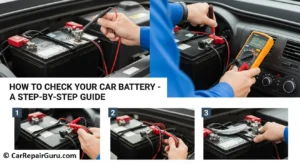
You don’t need to be a mechanic to perform a basic battery health check. Here are two easy methods, from a simple visual check to a more precise voltage test.
Method 1 – The Visual Inspection (No Tools Required)
This 2-minute check can reveal a lot about your battery’s condition.
- Safety First: Before you begin, make sure your engine is off. It’s always a good idea to wear safety glasses and gloves when working near a car battery.
- Step 1: Check the Terminals: Look closely at the positive (+) and negative (-) terminals. Do you see that crusty corrosion we mentioned? If so, it needs to be cleaned. A solid connection is critical for performance.
- Step 2: Check the Cables: Gently wiggle the cables connected to the terminals. They should be completely tight and unmovable. A loose connection can mimic the symptoms of a dead battery. Also, check the cables for any cracks or fraying.
- Step 3: Inspect the Battery Case: Scan the entire battery case. Look for any cracks, leaks, or signs of swelling. A swollen, bloated battery is a serious red flag indicating internal damage from heat or overcharging. If you see this, it’s time for a replacement.
Method 2 – The Multimeter Test (For a Precise Reading)
For a more accurate health report, a simple tool called a multimeter is your best friend. You can buy one for under $20 at any hardware or auto parts store.
- What You’ll Need: A digital multimeter.
- Step 1: Set the multimeter dial to DC Voltage (indicated by a V– or a straight line over a dotted line). Choose the 20V setting, as a car battery is a 12-volt system.
- Step 2: With the car engine completely OFF for at least a few hours, connect the probes. Touch the red probe to the positive (+) terminal and the black probe to the negative (-) terminal.
- Step 3: Read the Voltage and Interpret the Results: The number on the screen tells you the battery’s state of charge.
- 12.6V or above: Your battery is fully charged and in great shape.
- ~12.4V: It’s about 75% charged. This is generally okay.
- 12.2V – 12.3V: This is only a 50% charge. Your battery is getting weak, and it’s time to get it professionally tested.
- 12.0V or below: Your battery is significantly discharged. It may be unable to hold a charge and likely needs to be replaced soon.
Is It Really the Battery? How to Tell if it’s the Alternator or Starter
Sometimes, a no-start issue isn’t the battery’s fault. The summer heat stresses the entire starting and charging system. Here’s how to tell the difference between a bad battery, alternator, or starter.
Signs of a Bad Alternator
The alternator’s job is to recharge your battery while the engine is running. If it fails, your battery will quickly drain and die.
- Key Symptom: The car starts fine with a jump-start but dies shortly after the jumper cables are removed.
- The battery warning light stays illuminated on your dashboard while you are driving.
- Your headlights and interior lights pulse from bright to dim as you rev the engine.
- You hear a distinct whining or grinding noise from the engine bay that changes pitch with your engine’s speed.
Signs of a Bad Starter
The starter is the small motor that uses the battery’s power to physically turn the engine over.
- Key Symptom: You turn the key, all your dashboard lights come on, but you only hear a single, loud “CLICK” and the engine doesn’t crank.
- You hear a rapid clicking noise, which means the starter is trying to engage but doesn’t have enough power (this can also indicate a very weak battery).
- You hear a whirring or grinding sound, but the engine isn’t turning over.
What to Do When Your Battery Fails the Test
So, your visual inspection revealed a swollen case, or your multimeter test came back with a low voltage. What’s next?
- Get a Professional Confirmation: The easiest first step is to drive to a local auto parts store (like AutoZone, O’Reilly, Advance Auto Parts). Most of them offer a free, comprehensive battery and charging system test. This test is more advanced than a simple multimeter reading and can check the battery’s overall health and Cold Cranking Amps (CCA), giving you a definitive answer.
- Choosing the Right Replacement Battery: If you need a new car battery, your owner’s manual is the best place to find the correct specifications (group size, terminal location, etc.). For hot climates, consider upgrading to an AGM (Absorbed Glass Mat) battery. They are sealed, more resistant to vibration, and handle high temperatures and deep discharging cycles much better than traditional batteries.
- DIY vs. Professional Installation: Replacing a battery is a manageable DIY job for many cars. Just be sure to follow safety precautions (always disconnect the negative terminal first!). However, many auto parts stores offer free installation with the purchase of a new battery, which is a fantastic, hassle-free option.
Summer Car Battery Maintenance & Prevention Tips
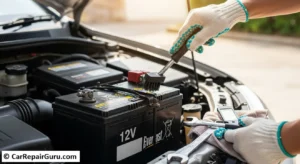
An ounce of prevention is worth a pound of cure. Follow these summer car care tips to extend your battery’s life:
- Park in the Shade: This is the simplest tip. Parking in a garage or under a shady tree can significantly lower the under-hood temperature, reducing stress on the battery.
- Keep it Clean: If you saw corrosion on the terminals, clean it off. A simple mixture of baking soda and water applied with an old toothbrush works wonders. Rinse with a little water and dry thoroughly.
- Limit Short Trips: Frequent, short drives (under 20 minutes) don’t give your alternator enough time to fully recharge the battery after starting. Try to combine errands into one longer trip.
- Use a Battery Tender: If your car will be parked for an extended period (like a week-long vacation), a battery tender is a smart investment. It keeps the battery at an optimal charge level without overcharging it.
Final Thoughts – Don’t Let the Heat Leave You Stranded
Your car’s battery is the unsung hero of your summer adventures. Ignoring it is a gamble that rarely pays off. By taking just five minutes for a quick visual check or a multimeter test, you can catch problems early and avoid the miserable experience of being stranded on a hot day.
Remember the key takeaways: summer heat is the real enemy, the warning signs are easy to spot, and a little preventative maintenance goes a very long way. Now, go check your battery and enjoy a worry-free summer on the road!
Frequently Asked Questions (FAQ)
How Long Do Car Batteries Last in Hot Climates?
In areas with consistent high heat, a car battery’s lifespan is often reduced to just 2-3 years. The constant thermal stress accelerates internal degradation much faster than in cooler regions.
Can a Car Battery Die Suddenly Without Warning?
Yes, it’s possible. Intense heat can cause an internal component to fail abruptly, leading to a sudden death even if the car started fine just hours earlier. This is why preventative checks are so important.
Is Cleaning Battery Corrosion a Permanent Fix?
Cleaning the terminals restores a good connection but doesn’t fix the underlying cause. Corrosion is often a symptom of an aging battery leaking gas, so it’s a strong sign a replacement is needed soon.
Does Auto Start-Stop Wear Out a Battery Faster in Summer?
Absolutely. This feature forces frequent restarts, putting a heavy load on the battery. In summer, the battery must power the A/C and other systems during a stop, which significantly accelerates wear.
Can a Weak Battery Affect Car Performance?
A failing battery can provide inconsistent voltage to your car’s computer and electronics. This can lead to issues like poor fuel economy, rough idling, or hesitation during acceleration.
About the Author