Marco
If your car stereo sounds flat, the bass is weak, or your music becomes distorted when you turn up the volume, you may not need to replace the entire system. In many cases, you can improve sound quality by adjusting the audio settings, checking the speakers, reducing unwanted vibrations, or upgrading one component at a time.
The best approach depends on what is wrong with your current setup. A speaker upgrade may improve clarity, an amplifier may provide cleaner power, and a subwoofer may deliver deeper bass. However, choosing the wrong equipment or installing it incorrectly can waste money and create new problems.
This guide explains how to improve your car sound system step by step, from simple adjustments to speaker upgrades, sound damping, amplifiers, subwoofers, and installation safety.
- 1. Identify What Is Wrong With Your Car Sound System
- Test the system before making changes
- 2. Improve Sound Quality Without Replacing Parts
- Use a good-quality audio source
- Adjust the equalizer carefully
- Check for damaged speakers and loose trim
- 3. Reduce Door Vibrations With Suitable Sound Damping
- Where sound-damping material helps
- Install the material correctly
- 4. Upgrade Your Car Speakers
- Coaxial speakers vs. component speakers
- Check speaker size, impedance, and sensitivity
- 5. Decide Whether You Need an Amplifier
- When an amplifier may help
- Understand RMS power ratings
- Keep the factory radio when appropriate
- 6. Add a Subwoofer for Deeper Bass
- Choose a subwoofer that suits your vehicle
- Set the crossover and bass level correctly
- 7. Check Wiring, Fuses, and Electrical Safety
- Use suitable power wiring and fusing
- Understand alternator noise and battery drain
- 8. Avoid Common Car Audio Upgrade Mistakes
- Turning the volume or gain up too far
- Replacing every component at once
- Ignoring factory-system compatibility
- Assuming sound damping fixes every noise
- 9. Should You Install the System Yourself or Hire a Professional?
- When DIY installation may be suitable
- When professional installation is the better option
- 10. A Practical Upgrade Plan for Better Car Audio
- Final Thoughts
- Frequently Asked Questions
- Can I improve my car sound system without replacing the factory radio?
- Do new car speakers need an amplifier?
- Why do my new speakers sound worse than the original speakers?
- Does sound-deadening material improve car audio?
- Can adding an amplifier drain the car battery?
- What crossover frequency should I use for a car subwoofer?
- Is a bigger amplifier always better?
- What is the best first upgrade for better car sound?
1. Identify What Is Wrong With Your Car Sound System
Before buying new equipment, identify the problem you want to solve. Different symptoms point to different possible causes, and replacing parts without checking the system can lead to unnecessary expenses.
| What you notice | Possible causes | What to check first |
|---|---|---|
| Music sounds unclear or dull | Speaker limitations, poor source quality, or unsuitable audio settings | Check the source, EQ, balance, and speaker condition |
| Bass sounds weak | Limited speaker bass response, incorrect settings, or a subwoofer that is missing or poorly integrated | Check bass settings and speaker operation before considering a subwoofer |
| Sound distorts at high volume | Amplifier clipping, damaged speakers, excessive bass boost, or insufficient clean power | Reduce the volume and bass boost, then test each speaker |
| Doors or dashboard rattle | Loose trim, vibrating panels, or unsecured components | Locate the vibration before adding sound-deadening material |
| One speaker is quieter or silent | Speaker damage, wiring problems, balance settings, or an amplifier fault | Check the audio settings and connections, then diagnose the affected channel |
| Whining or buzzing noise | Electrical interference, grounding problems, poor connections, or a faulty component | Identify when the noise occurs and inspect the system systematically |
Test the system before making changes
Park the vehicle in a safe place and play a familiar song with clear vocals, instruments, and bass. Start at a moderate volume and listen carefully.
- Adjust the balance to check the left and right speakers.
- Use the fader to check the front and rear speakers, if fitted.
- Return the bass, midrange, and treble settings to neutral before evaluating the system.
- Listen for distortion, buzzing, rattling, or missing frequencies.
- Repeat the test with another audio source to determine whether the problem follows the source or remains with the vehicle.
If the system suddenly sounds worse than it used to, investigate a possible fault before purchasing upgrades. A damaged speaker or loose connection requires a different solution from a system that simply lacks bass.
2. Improve Sound Quality Without Replacing Parts
Simple adjustments can improve your listening experience without changing the factory radio or speakers. Start with the source and settings before spending money on new equipment.
Use a good-quality audio source
The quality of the original recording and audio file affects what you hear through your speakers. A poorly recorded track or heavily compressed audio file may sound harsh or lack detail, even with good equipment.
When possible, compare the same song using a reliable source and a consistent volume. Bluetooth, USB, and wired connections can produce different results depending on the phone, vehicle, codec, audio processing, and connection. USB is not automatically better in every vehicle.
Also check whether your phone or music application has an equalizer, volume normalization, or sound enhancement enabled. Multiple layers of audio processing can make it harder to identify the real cause of poor sound quality.
Adjust the equalizer carefully
The equalizer, or EQ, lets you adjust different frequency ranges. Bass controls affect low frequencies, midrange controls affect much of the body of voices and instruments, and treble controls affect higher-frequency detail.
- Bass: Increase it slightly if the sound lacks low-frequency weight, but avoid excessive boosts that make small speakers distort.
- Midrange: Keep voices and instruments natural. Large cuts or boosts can make music sound hollow or harsh.
- Treble: Adjust it gradually if the sound seems dull or too sharp.
- Balance and fader: Use these controls to check speaker output and create a comfortable listening position.
Start with a neutral EQ and make small changes. There is no single setting that works for every car, speaker system, or music style. If you need to increase bass or treble dramatically to make the system sound acceptable, the speakers, installation, or factory audio processing may be limiting performance.
Check for damaged speakers and loose trim
A torn speaker cone, deteriorated surround, loose grille, or damaged mounting point can cause buzzing and distortion. Door panels and dashboard trim can also vibrate when certain bass frequencies play.
Listen carefully to determine where the sound originates. If you suspect a speaker is damaged, inspect it only if you can safely access it without damaging the trim, wiring, or airbag components. Do not assume every rattle comes from the speaker itself.
If the problem appears to be an electrical or radio fault, read our guide to how to troubleshoot common car radio problems before replacing audio equipment.
3. Reduce Door Vibrations With Suitable Sound Damping
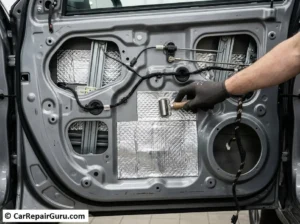
Door panels can vibrate when speakers produce low and midrange frequencies. Suitable sound-damping material can reduce some of these vibrations, helping the system sound cleaner and reducing unwanted rattles.
Sound damping is not the same as soundproofing the entire vehicle. It also does not automatically turn a door into a properly sealed speaker enclosure. The result depends on the material, installation, door construction, and speaker design.
Where sound-damping material helps
Depending on the vehicle and the source of the noise, treatment may be useful on suitable metal door panels, around vibrating trim, or in other areas where panel resonance has been identified.
For a speaker upgrade, the installer may also improve the speaker mounting surface and address gaps or openings that affect acoustic performance. These steps are separate from simply applying damping material to a panel.
Install the material correctly
- Identify the vibrating panel or component before adding material.
- Use products designed for automotive interiors and the intended location.
- Keep drains, window tracks, moving parts, wiring, and service access clear.
- Do not obstruct side-impact airbags or other safety equipment.
- Follow the material manufacturer’s preparation and installation instructions.
Adding more material is not always better. Correct placement and secure installation matter more than covering every surface indiscriminately.
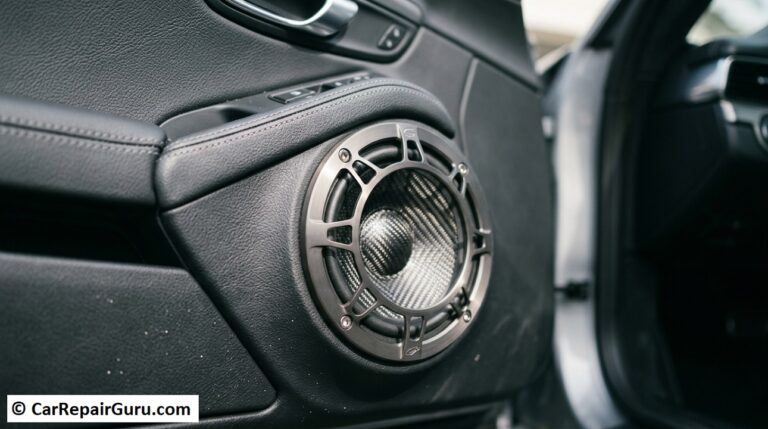
4. Upgrade Your Car Speakers
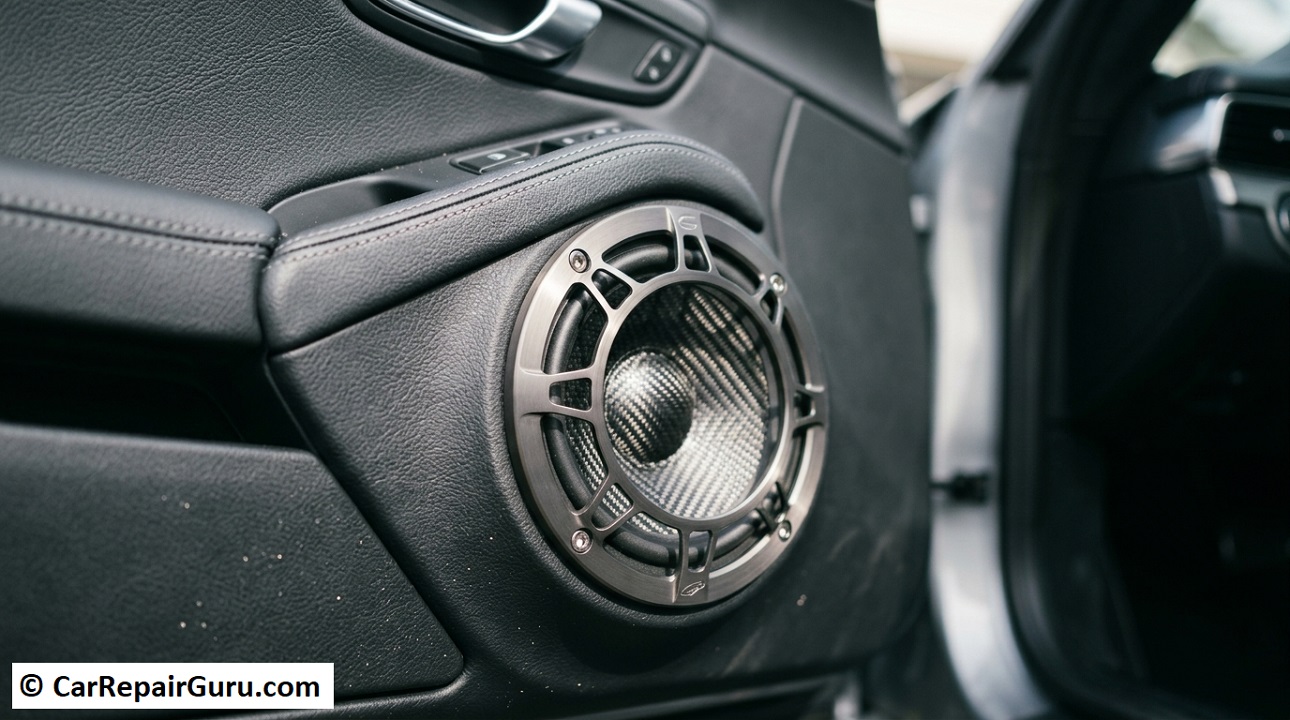
If the factory speakers sound dull, distort at normal listening levels, or cannot reproduce the detail you want, replacing them may be a useful first hardware upgrade. You do not necessarily need a new radio to improve sound quality.
However, a replacement speaker must match the vehicle’s mounting dimensions, electrical requirements, and available installation depth. Some factory systems also use unusual speaker impedances, built-in amplification, or audio processing that affects compatibility.
Coaxial speakers vs. component speakers
| Speaker type | How it works | Best suited for |
|---|---|---|
| Coaxial speakers | Combine multiple frequency drivers in one assembly | Drivers looking for a straightforward replacement in compatible factory locations |
| Component speakers | Use separate drivers, commonly woofers and tweeters, with suitable crossover components | Drivers seeking more control over speaker placement and front-stage sound quality |
Coaxial speakers are often simpler to install because the main drivers are combined in one assembly. They can be a practical choice when you want better sound without extensive modifications.
Component speakers separate the woofer and tweeter. When installed and tuned correctly, their placement can improve stereo imaging and detail. They may require more installation work, suitable mounting locations, and careful crossover integration.
Check speaker size, impedance, and sensitivity
Do not choose speakers based on size alone. Before buying, verify these specifications for your exact vehicle and audio system:
- Fit and mounting depth: Confirm the speaker fits the opening and will not interfere with the window, door hardware, or trim.
- Impedance: Check the speaker’s electrical resistance rating as specified by the manufacturer and make sure it is compatible with the factory or aftermarket amplifier.
- Sensitivity: This indicates how efficiently a speaker converts power into sound under a specified test method. Higher sensitivity can be helpful when using limited-power factory equipment, but ratings should be compared using consistent methods.
- RMS power handling: This describes the speaker’s rated ability to handle continuous audio power under specified conditions. It is not a guarantee of sound quality.
- Frequency response: Review the stated range, but remember that the numbers alone do not tell you how evenly or accurately a speaker reproduces sound.
A speaker with a high power-handling rating does not automatically sound better. The best choice is one that fits the vehicle, works with the available power, and meets your listening goals.
For more information about factory-system compatibility and upgrade options, see this guide to upgrading a factory car sound system.
5. Decide Whether You Need an Amplifier
An amplifier supplies electrical power to the speakers. Adding a suitable amplifier can improve clean output and reduce the need to push a low-powered source to its limits. It can be especially useful if the speakers sound acceptable at low volume but become harsh or distorted when you turn the music up.
However, an amplifier is not a universal fix. It will not repair a damaged speaker, eliminate a loose-panel rattle, or correct a poor recording. The source, speakers, wiring, and amplifier must work together as a system.
When an amplifier may help
- You want higher listening levels with less distortion.
- Your replacement speakers need more clean power than the factory system can provide.
- You are adding a subwoofer that requires dedicated amplification.
- You want more control over system tuning and component integration.
Understand RMS power ratings
When comparing amplifiers and speakers, focus on their RMS power specifications and the conditions under which those ratings were measured. Peak or maximum power figures are not directly comparable to continuous power ratings.
Check the amplifier’s rated output at the speaker impedance you intend to use. Also confirm that the speakers can work safely with the amplifier and that the system’s gain and crossover settings are configured correctly.
Amplifier gain is not simply a volume control. It matches the amplifier’s input sensitivity to the signal from the radio or audio processor. Setting it too high can cause clipping and distortion, potentially damaging speakers or other equipment.
Keep the factory radio when appropriate
Many vehicles can be upgraded while retaining the original radio. Depending on the vehicle, you may need an amplifier with speaker-level inputs, a line output converter, a digital signal processor, or a vehicle-specific integration harness.
Modern infotainment systems may also control climate settings, vehicle functions, warning sounds, cameras, or other features. Replacing the factory unit without checking compatibility can cause problems beyond audio quality.
Before purchasing equipment, confirm the correct integration method for your vehicle, especially if it has a factory amplifier or premium audio package.
6. Add a Subwoofer for Deeper Bass
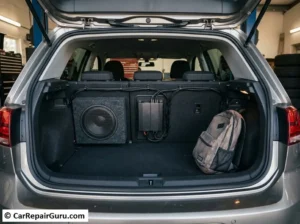
If you want deeper bass than your door speakers can provide, adding a subwoofer may be the most direct solution. A subwoofer is designed to reproduce low frequencies, allowing the main speakers to focus on the frequencies they handle more effectively.
A typical subwoofer system includes a subwoofer driver, an enclosure, and an amplifier. A powered subwoofer combines the driver and amplifier in one unit, which can simplify installation.
Choose a subwoofer that suits your vehicle
- Powered subwoofer: A convenient option when you want a compact, integrated solution.
- Separate subwoofer and amplifier: Offers more flexibility when choosing output, enclosure design, and system configuration.
- Compact or under-seat subwoofer: May suit vehicles with limited cargo space, although bass output and fit depend on the specific model and installation.
- Larger enclosure system: Can provide stronger bass, but it requires suitable space and careful matching of the driver, enclosure, and amplifier.
Consider the available space, the type of music you listen to, the desired bass level, and how much installation work you are prepared to undertake. A larger subwoofer is not automatically the best option for every vehicle.
Set the crossover and bass level correctly
A crossover directs different frequency ranges to the speakers that are best suited to reproduce them. A subwoofer’s low-pass filter limits the higher frequencies it plays, while a high-pass filter can reduce low-frequency demands on smaller speakers.
A setting around 80 Hz is sometimes used as a starting point for a subwoofer crossover, but it is not a universal rule. The appropriate setting depends on the main speakers, subwoofer, enclosure, vehicle acoustics, and available controls.
Adjust the settings gradually and listen for a smooth transition between the subwoofer and the main speakers. If the bass sounds disconnected, boomy, or weaker than expected, check the crossover, phase, placement, and integration rather than simply turning up the subwoofer.
7. Check Wiring, Fuses, and Electrical Safety
Amplifiers and powered subwoofers can draw substantial current. Incorrect wiring can cause poor performance, equipment damage, battery problems, or fire. Electrical work should be planned around the equipment manufacturer’s instructions and the vehicle’s electrical system.
Use suitable power wiring and fusing
The required power cable size depends on factors such as current draw, cable length, conductor material, installation conditions, and the applicable manufacturer’s guidance. Do not choose a cable gauge based only on the amplifier’s advertised wattage.
The power circuit must also be protected by a correctly rated fuse installed in the location specified by the equipment instructions. The fuse must protect the wiring and be appropriate for the circuit. A larger fuse is not a safe substitute for undersized cable.
- Use the correct cable, connectors, and terminals for the installation.
- Protect power cables from sharp edges, heat, moving parts, and abrasion.
- Route cables away from pedals, seat mechanisms, and safety equipment.
- Follow the vehicle and equipment instructions for battery disconnection and reconnection.
- Check ground connections and cable routing if electrical noise occurs.
- Do not bypass a fuse or install a higher-rated fuse to stop it from blowing.
If you are unfamiliar with automotive electrical work, have a qualified installer complete the power connections. For related troubleshooting, see our guide to common car electrical problems.
Understand alternator noise and battery drain
A whining noise that changes with engine speed can indicate electrical interference, but it does not prove that a ground loop is the cause. Faulty grounding, poor cable routing, damaged components, and other issues can produce similar symptoms. Diagnose the cause before replacing parts or adding grounding cables.
Likewise, an amplifier does not automatically drain the battery simply because it is installed. Battery drain may occur if the equipment remains powered when the vehicle is off, if the remote turn-on circuit is incorrect, or if another electrical fault is present. A remote turn-on wire alone does not guarantee that every system will shut down correctly.
If the vehicle develops repeated battery discharge, flickering lights, blown fuses, hot wiring, or a burning smell after an audio installation, stop using the affected equipment and have the electrical system inspected.
8. Avoid Common Car Audio Upgrade Mistakes
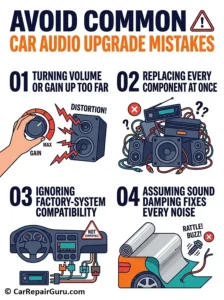
Buying more powerful equipment is not enough to guarantee better sound. The installation, component compatibility, and tuning are just as important.
Turning the volume or gain up too far
Excessive volume, aggressive EQ boosts, or an incorrectly set amplifier gain can cause clipping and distortion. If the sound becomes harsh, reduce the level and investigate the cause instead of continuing to increase the volume.
Replacing every component at once
Replacing the radio, speakers, amplifier, and subwoofer simultaneously can make it difficult to identify which change helped or caused a problem. Unless you are planning a complete system from the beginning, upgrade in stages.
Start with the issue that bothers you most. If a speaker is damaged, fix it first. If the sound is clear but lacks deep bass, consider a subwoofer. If the speakers distort at higher levels, assess their condition, the source output, and whether a suitable amplifier is needed.
Ignoring factory-system compatibility
Some vehicles use factory equalization, separate amplifier channels, unusual speaker impedances, or integrated infotainment functions. A replacement speaker or amplifier that works well in one vehicle may not be suitable for another.
Confirm the compatibility of each component before buying it. Use vehicle-specific fitment information and wiring instructions instead of relying on a general assumption about speaker sizes or power ratings.
Assuming sound damping fixes every noise
Sound-damping material can reduce panel vibration, but it will not fix a loose connector, damaged speaker, poorly secured trim piece, or electrical interference. Identify the source of the noise first and choose a solution that addresses it directly.
9. Should You Install the System Yourself or Hire a Professional?
The right choice depends on your experience, the vehicle, and the complexity of the installation.
When DIY installation may be suitable
A straightforward speaker replacement may be manageable if you have the correct tools, vehicle-specific instructions, compatible parts, and experience working carefully with interior trim. Some vehicles have simple access, while others require extensive disassembly.
Before starting, check whether the work involves side airbags, complex door wiring, factory amplifiers, vehicle-network connections, or other sensitive systems. Never probe or modify airbag wiring as part of an audio installation.
When professional installation is the better option
Consider a qualified car audio installer if the vehicle has a complex factory system, if you need to run high-current power cables, if you are installing multiple amplifiers, or if you cannot confidently identify the correct wiring and integration method.
Professional installation may also be worthwhile when you want a carefully tuned system with a digital signal processor, multiple crossover points, or a custom subwoofer enclosure.
10. A Practical Upgrade Plan for Better Car Audio
You do not need to purchase everything at once. Use the following sequence to focus your budget on the changes most likely to solve your specific problem.
- Diagnose the sound: Identify distortion, weak bass, poor clarity, rattles, or a speaker that is not working.
- Check the basics: Test the audio source, EQ, balance, fader, speaker condition, and visible connections.
- Fix existing faults: Repair damaged speakers, loose trim, or wiring problems before adding upgrades.
- Improve the speakers: Choose compatible replacement speakers if clarity or speaker performance is the main limitation.
- Address vibrations: Apply suitable sound damping where you have identified panel resonance or unwanted rattles.
- Add amplification if needed: Use a compatible amplifier when the system needs more clean output.
- Add a subwoofer if desired: Choose a system that fits your space and bass preferences.
- Tune the complete system: Adjust gain, crossovers, EQ, and subwoofer integration carefully.
- Verify the installation: Check that the system operates correctly and that wiring, fuses, and factory functions remain safe and reliable.
For many drivers, the best upgrade is not the most expensive one. It is the component or adjustment that solves the actual problem without introducing new compatibility or installation issues.
Final Thoughts
Improving your car sound system starts with understanding what you want to change. Adjusting the audio settings and checking the speakers can solve some problems without spending money. When an upgrade is needed, compatible speakers, suitable sound damping, a properly matched amplifier, or a subwoofer can improve the listening experience.
Make changes in stages, confirm compatibility before buying equipment, and treat wiring and electrical safety as priorities. A well-matched and correctly installed system will usually deliver better results than simply choosing the most powerful components.
Frequently Asked Questions
Can I improve my car sound system without replacing the factory radio?
Yes. You may be able to improve the system by adjusting the EQ, replacing compatible speakers, reducing door vibrations, adding a suitable amplifier, or installing a powered subwoofer. The available options depend on the vehicle’s factory audio system and how its components are integrated.
Do new car speakers need an amplifier?
Not always. Many replacement speakers can work with a factory radio if their impedance, sensitivity, and power requirements are suitable. An external amplifier may help when you need more clean output, but it is not necessary for every speaker upgrade.
Why do my new speakers sound worse than the original speakers?
Possible causes include incompatible impedance, incorrect wiring, poor mounting, a reversed speaker connection, factory audio processing, unsuitable EQ settings, or an amplifier that is clipping. Check compatibility and installation before assuming the speakers themselves are defective.
Does sound-deadening material improve car audio?
It can reduce unwanted panel vibration and some rattles, which may make music sound cleaner. Results depend on where and how the material is installed. It will not automatically fix damaged speakers, electrical noise, or every source of road noise.
Can adding an amplifier drain the car battery?
An amplifier that is correctly installed and switches off as intended should not normally cause excessive battery drain when the vehicle is parked. Incorrect remote turn-on wiring, equipment faults, or other electrical problems can leave components drawing current. If the battery repeatedly discharges after installation, have the system checked.
What crossover frequency should I use for a car subwoofer?
Around 80 Hz can be a useful starting point in some systems, but the correct setting depends on the speakers, subwoofer, enclosure, vehicle acoustics, and available controls. Adjust the crossover to achieve a smooth transition between the subwoofer and the main speakers.
Is a bigger amplifier always better?
No. An amplifier should provide suitable clean power for the speakers and be compatible with their impedance and the rest of the system. Excessive gain, clipping, or poor installation can cause distortion and damage even when the equipment has a high power rating.
What is the best first upgrade for better car sound?
It depends on the problem. If the factory speakers are worn or lack clarity, compatible replacement speakers may be a good starting point. If the sound is already clear but lacks deep bass, a suitable subwoofer may be more useful. Diagnose the system first, then choose the upgrade that addresses its main limitation.
About the Author