 Marco
Marco 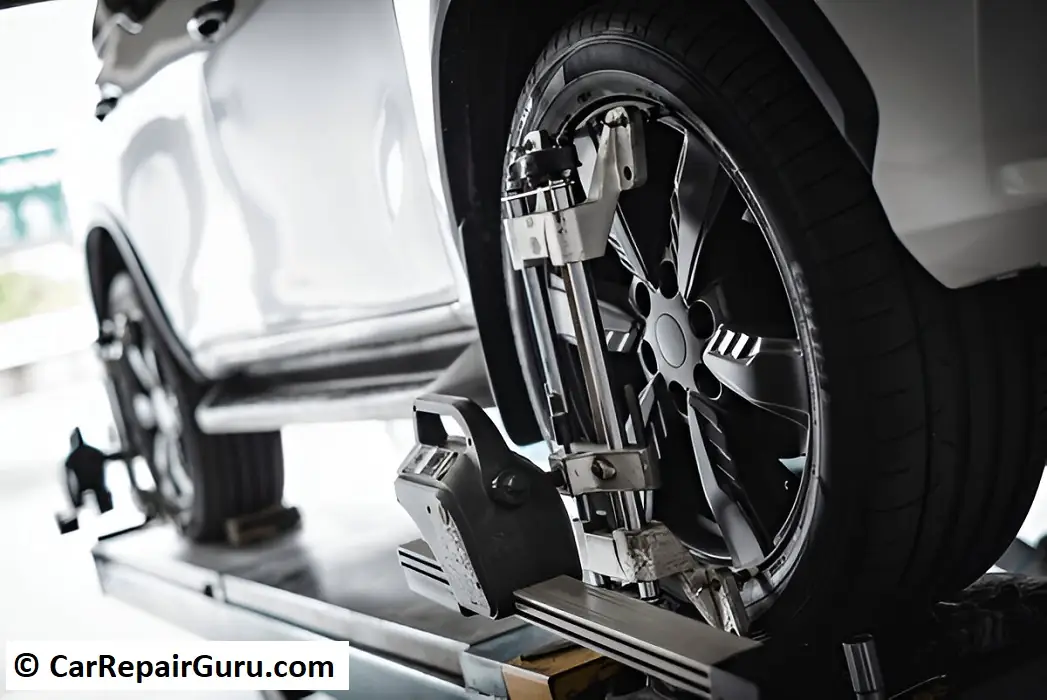
We have all had that sinking feeling – you walk out to your driveway on a Sunday morning, glance down at your front tires, and realize the inside tread is chewed down to the steel cords on a set of rubber you bought six months ago. Maybe your steering wheel sits off-center on a flat highway, or you find yourself constantly fighting a gentle pull toward the ditch.
As an ASE Certified Master Technician with over 15 years in the shop, I see drivers dealing with this frustration every single week. When you take the car in, the service desk hands you a printout covered in red and green numbers, degrees, and minutes that look like high school geometry homework. In reality, your car depends on three-dimensional geometry to stay stable on the road. Understanding your vehicle’s alignment angles gives you the knowledge to protect your tires, spot suspension damage early, and know whether your repair shop is doing the job right.
- Camber Angle – The Inward and Outward Tire Tilt
- Caster Angle – The Force That Centers Your Steering Wheel
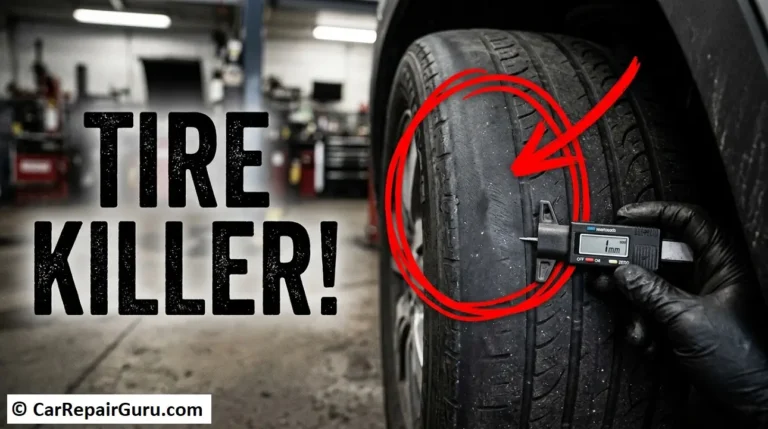
- Toe Angle – The Silent Number One Tire Killer
- Secondary Alignment Angles – SAI, Included Angle, and Thrust
- How to Read an Alignment Printout Sheet
- Troubleshooting Alignment Symptoms vs Wheel Balance Issues
- DIY String Alignments vs High-End Computerized Racks
- Suspension Maintenance to Keep Alignment Angles Locked
- Summary from the Garage Floor
- Frequently Asked Questions
- Can hitting a pothole throw off alignment angles immediately?
- What is the difference between a front-end alignment and a four-wheel alignment?
- Why does my car pull to the right even after a fresh alignment?
- How often should I have my car’s alignment angles checked?
Camber Angle – The Inward and Outward Tire Tilt
Camber represents the vertical tilt of your wheels when looking directly at the front or rear of your car. If the top of the tire leans inward toward the engine bay, that is negative camber. If the top of the tire leans outward away from the car, that is positive camber. When the wheel sits completely perpendicular to a flat road surface, the camber reading is zero.
Improves cornering grip, but wears down the inside shoulder if excessive.
Ensures flat contact for highway cruising, but scrubs tire edges during fast turns.
Found on loaded work trucks, but eats the outside shoulder on passenger cars.
Most modern passenger cars and performance vehicles come from the factory with a slight amount of negative camber (usually between -0.5 and -1.2 degrees). When you take a hard turn, body roll naturally forces the outside tire upright. That slight negative angle ensures the widest possible contact patch grips the pavement during cornering. However, when road impacts or worn suspension parts push negative camber past factory tolerances, the inside shoulder of the tire carries all the vehicle’s weight, wearing down to the cords in just a few thousand miles.
Pro-Tip from the Shop Floor – If a mechanic tells you that camber cannot be adjusted on your MacPherson strut setup after a front-end repair, ask if aftermarket camber adjustment bolts (often called crash bolts) or adjustable top mounts are available for your chassis before spending money on new structural components.
- Negative Camber Symptoms: Heavy wear on the inside shoulder of the tire, aggressive cornering grip, slight pulling if one side has more negative tilt than the other.
- Positive Camber Symptoms: Premature wear on the outside shoulder of the tire, reduced high-speed cornering stability, vehicle pulling toward the side with more positive camber.
- Zero Camber Symptoms: Flat tread wear during pure highway driving, but increased outer shoulder scrubbing during aggressive turns.
Caster Angle – The Force That Centers Your Steering Wheel
Caster is the forward or rearward tilt of your steering axis when viewed from the side of the vehicle. Imagine a straight line drawn through the upper strut mount down through the lower ball joint. If that imaginary line tilts toward the back of the car (toward the driver), you have positive caster. If the line tilts forward toward the front bumper, you have negative caster.
You interact with positive caster every time you push a shopping cart or ride a bicycle. The front fork of a bicycle extends forward, placing the tire’s contact patch behind the steering pivot point. This mechanical trail creates a self-centering torque that wants to keep the wheel rolling straight. Modern cars run significant positive caster to deliver highway stability and automatically return the steering wheel to center after completing a turn.
Important Safety Insight – Caster does not cause direct tire wear because the tire still sits flat on the pavement while driving straight. However, cross-caster (the difference in caster between the left and right wheels) must stay within 0.5 degrees. If your left wheel has more positive caster than your right wheel, your car will pull hard to the right.
| Caster Setting | Mechanical Effect | Driver Experience |
|---|---|---|
| High Positive Caster | Increases steering centering force and high-speed directional tracking | Heavier steering effort at parking speeds, rock-solid highway cruising |
| Low / Neutral Caster | Reduces effort required to turn the steering wheel | Light steering feel, but the car tends to wander and blow around in crosswinds |
| Negative Caster | Places contact patch ahead of steering pivot (rare on modern cars) | Extremely unstable at speed, erratic steering return, dangerous wandering |
Toe Angle – The Silent Number One Tire Killer
Toe is by far the most critical alignment setting for tire longevity. Imagine looking down at your vehicle from a bird’s-eye view. If the front edges of the front tires point inward toward the vehicle centerline, you have toe-in (pigeon-toed). If the front edges point outward away from each other, you have toe-out (duck-footed).
Front Points IN
Front edges of the tires point toward the center of the car. Stabilizes straight highway tracking.
Front Points OUT
Front edges point away from the center. Sharpens turn-in response for track cars, but causes highway wandering.
Even a fraction of an inch of incorrect toe will ruin a set of tires faster than bad camber ever could. When toe is misaligned, the tires do not roll freely down the road. Instead, they are forced to scrub sideways across the pavement with every foot of forward motion. A toe setting that is out of spec by just 1/8 of an inch drags your tires sideways roughly 28 feet for every mile driven.
Common Mechanic Mistake to Avoid – Never let anyone adjust only one tie rod to straighten a crooked steering wheel without measuring total toe across both wheels on an alignment rack. Centering the steering wheel blindly can push individual toe angles way out of spec, introducing severe bump steer over rough roads.
- Park your vehicle on flat ground and turn the steering wheel completely to one side to expose the front tire tread.
- Run your bare palm smoothly across the tread face from the inside shoulder toward the outside shoulder.
- Run your hand back in the opposite direction, from the outside shoulder toward the inside shoulder.
- If the tread feels smooth in one direction but catches your fingertips like the scales of a fish in the other direction, your tire has “feathering” caused by incorrect toe.
- Smooth toward the inside means toe-out; smooth toward the outside means toe-in.
Secondary Alignment Angles – SAI, Included Angle, and Thrust
While camber, caster, and toe are the primary adjustable settings, seasoned technicians rely on secondary alignment angles to diagnose structural damage caused by severe pothole strikes or curb collisions.
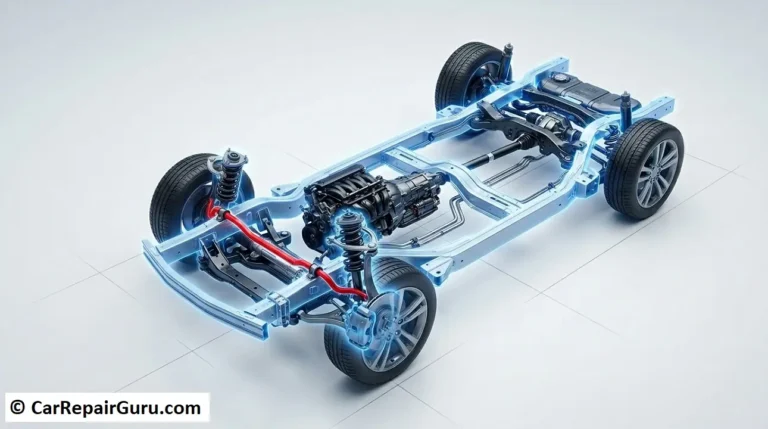
Steering Axis Inclination (SAI) is the inward tilt of the steering axis looking from the front, measured from true vertical. When combined with camber, it forms the Included Angle (IA). Because SAI and IA are engineered directly into the spindle, knuckle, and strut mounting geometry, they are rarely adjustable on production vehicles. If your camber is out of spec and your SAI reading does not match the opposite side of the vehicle, you are dealing with a bent spindle, a bent strut housing, or a shifted subframe.
STRUCTURAL DIAGNOSTIC
Inward tilt from top strut mount to lower ball joint relative to vertical.
Tilt of the actual wheel and tire face relative to vertical.
SAI + Camber = IA (Fixed angle built directly into the steering knuckle).
Thrust angle measures the direction the rear axle points relative to the vehicle’s centerline. If the rear axle is cocked sideways due to worn trailing arm bushings or rear subframe shifting, the car will push sideways, forcing the driver to turn the front wheels slightly just to keep the vehicle traveling straight.
Crucial Inspection Rule – If your alignment sheet shows a thrust angle greater than 0.05 degrees, the rear suspension must be adjusted or repaired before any front-end adjustments will hold a straight line.
| Secondary Angle | What It Measures | Diagnostic Clue If Out of Spec |
|---|---|---|
| Steering Axis Inclination (SAI) | Inward tilt of steering pivot line from vertical (front view) | Bent steering knuckle, bent strut body, or shifted engine cradle |
| Included Angle (IA) | Sum of Camber Angle plus Steering Axis Inclination | Confirms whether suspension damage is above or below the hub |
| Thrust Angle | Direction rear wheels push relative to car geometric centerline | Bent rear control arm, worn trailing bushings, or rear collision damage |
| Setback | Difference in front-to-back wheel placement between sides | Bent lower control arm, damaged subframe mount, or curb impact |
How to Read an Alignment Printout Sheet
When an alignment technician hands you a printout after service, it is easy to get overwhelmed by the wall of data. Knowing how to read these sheets ensures you get what you paid for.
ALL SPECS IN TOLERANCE
Every standard alignment sheet divides data into three columns: Initial (where your car sat when it rolled onto the rack), Final (where the angles sit after adjustments), and Specified Range (the factory minimum and maximum tolerances). Green indicators mean the angle is within tolerance, while red indicates an out-of-spec condition.
Shop Transparency Tip – Do not settle for just seeing green on individual wheels. Check the “Cross Values” row. A vehicle can have both front wheels technically in the green for caster, but if the left is at the maximum limit (+4.0 degrees) and the right is at the minimum limit (+3.0 degrees), that full 1.0-degree cross-caster split will pull the vehicle hard to the right.
- Final Toe Readings: Make sure total front and rear toe are matched evenly side to side, close to the factory nominal target rather than resting on the ragged edge of tolerance.
- Cross Camber and Cross Caster: Look for differences under 0.5 degrees between left and right sides to avoid unwanted pull or drift.
- Rear Axle Specs First: Verify the technician adjusted the rear wheels before setting the front; adjustments made to the rear change how the front tracks.
- Thrust Angle Reading: Ensure this reading sits as close to 0.00 degrees as mechanically possible.
Troubleshooting Alignment Symptoms vs Wheel Balance Issues
Drivers often confuse wheel balance vibrations with wheel alignment issues, resulting in wasted money on the wrong repairs.
Alignment Issue
- Vehicle pulls or drifts toward the shoulder
- Steering wheel is crooked when driving straight
- Tires show one-sided shoulder or feathered wear
- Does not cause steering wheel vibration
Wheel Balance Issue
- Steering wheel shakes at highway speeds (55 – 70 mph)
- Vibration felt through the floorboards or seat cushions
- Tread develops cupped, scalloped, or wavy dips
- Does not cause the car to pull to one side
Suspension geometry problems cause pulling, steering wander, and uneven tread wear, but they rarely create mechanical vibrations. If your steering wheel shakes at 60 mph, or you feel a rhythmic thumping through the driver’s seat floorboards, you are dealing with an out-of-balance wheel, a bent wheel rim, or an out-of-round tire with separated internal belts.
Diagnostic Checkpoint – Radial tire pull occurs when a manufacturing defect or internal belt shift within the tire causes it to act like a cone, pulling the car sideways regardless of alignment settings. If your car pulls right, swap the two front tires left-to-right. If the car now pulls left, the issue is an internal tire defect, not your suspension geometry.
| Symptom Observed | Probable Root Cause | Primary Repair Solution |
|---|---|---|
| Steering wheel shakes at 55 – 70 mph | Front wheel out of balance or bent wheel rim | Dynamic wheel balancing or rim repair |
| Car drifts toward the shoulder on flat road | Unequal cross-caster or cross-camber | Four-wheel precision suspension alignment |
| Seat or cabin floor vibrates at speed | Rear wheel out of balance or separated tire belt | Road force balance rear tires; inspect tread |
| Rapid sawtooth wear on tire edges | Severe front or rear toe misalignment | Tie rod adjustment to reset total toe |
DIY String Alignments vs High-End Computerized Racks
With a pair of jack stands, masonry string, and an accurate steel ruler, you can measure and adjust total toe in your home garage with surprisingly good accuracy. In club racing and grassroots track days, string setups are used in the paddock regularly to make fast adjustments between track sessions.
However, attempting a full four-wheel alignment at home without optical or laser equipment falls short when assessing complex geometry. Measuring caster requires rotating the steering wheel through a precise 20-degree sweep while tracking camber change. Similarly, establishing a true vehicle centerline to measure rear thrust angle requires high-precision referencing that basic garage tools struggle to replicate.
Practical Workaround – If you replace tie rods, control arms, or struts in your home driveway, use the string method or a trammel bar to set front toe close to zero. This allows you to safely drive the car to a professional shop with a computerized alignment rack without scrubbing your tires bald on the trip over.
- DIY String Alignment Pros: Inexpensive, accessible anywhere, excellent for quick trackside toe corrections and post-repair emergency setups.
- DIY String Alignment Cons: Extremely time-intensive, prone to human measurement error, cannot reliably measure caster, SAI, or sub-degree thrust angles.
- Computerized Alignment Rack Pros: Measures all 14 primary and secondary angles simultaneously within hundredths of a degree; compensates for wheel runout.
- Computerized Alignment Rack Cons: Requires expensive professional shop labor ($100 – $250) and a qualified technician who understands how to interpret data rather than just setting toe.
Suspension Maintenance to Keep Alignment Angles Locked
An alignment rack only adjusts suspension components; it cannot fix worn-out parts. If your control arm bushings are torn, your ball joints have physical play, or your wheel bearings are loose, setting your wheels on an alignment rack is a complete waste of money. The moment the car rolls off the rack and hits the first bump, worn parts shift, throwing the angles out of specification immediately.
Rubber suspension bushings naturally soften and crack over years of road salt, oil leaks, and daily driving cycles. As these bushings compress under braking and acceleration, your wheels shift dynamically on the road, causing intermittent steering wander that never shows up on a stationary alignment machine.
Pre-Alignment Inspection Step – Before allowing any shop to perform an alignment, ask the technician to hoist the car and perform a physical suspension shakedown with a pry bar to check for loose ball joints, worn tie rod ends, and torn control arm bushings.
- Inner and Outer Tie Rod Ends: Check for side-to-side play; any looseness directly alters toe angle under driving load.
- Lower and Upper Ball Joints: Check for vertical and lateral movement; loose joints cause sudden camber and caster shifts.
- Control Arm Bushings: Inspect rubber for dry rot, tearing, or fluid leaks (on hydraulic bushings), which cause wheel movement under braking.
- Strut Mount Bearings and Bushings: Inspect the top of the strut tower for excessive play, binding, or clunking during steering rotation.
- Sway Bar End Links and Bushings: While they do not directly dictate angles, worn links cause uneven body roll that upsets dynamic geometry during cornering.
Summary from the Garage Floor
Suspension geometry does not have to remain a mystery hidden behind confusing shop printouts. Camber controls your tire contact patch across the road, caster gives you high-speed steering stability and wheel centering, and toe keeps your tires rolling cleanly forward instead of scrubbing sideways across the asphalt.
Whenever you replace steering parts, buy new rubber, or feel your vehicle wander across road lanes, take the time to inspect your suspension bushings and get your vehicle on a calibrated alignment rack. Keeping your alignment angles locked to factory specifications protects your tire investment, maximizes fuel economy, and keeps your vehicle tracking straight and safe on every drive.
Frequently Asked Questions
Can hitting a pothole throw off alignment angles immediately?
Yes. A severe pothole or curb impact concentrates thousands of pounds of force through the tire directly into the steering knuckle, tie rod, and strut. This force can slip adjustment eccentric bolts, bend a tie rod, or distort a stamped steel control arm, knocking your toe or camber out of specification instantly.
What is the difference between a front-end alignment and a four-wheel alignment?
A front-end alignment (often called a “toe-and-go”) only measures and adjusts the front steering components. A four-wheel alignment measures all four wheels and aligns the front wheels directly to the rear axle’s thrust line. Every modern vehicle with independent rear suspension or rear adjustment provisions requires a full four-wheel alignment.
Why does my car pull to the right even after a fresh alignment?
If your alignment sheet confirms that cross-camber and cross-caster are balanced, the issue is almost always road crown or radial tire pull. Most roads are paved with a downward slope toward the right shoulder to shed rainwater, which naturally pulls vehicles right. If the pull persists in the left lane of an undivided highway, swap the front tires left to right to check for an internal tire belt defect.
How often should I have my car’s alignment angles checked?
Have your alignment checked once a year or every 12,000 to 15,000 miles, preferably when installing new tires or during seasonal tire swaps. You should also get an immediate alignment inspection anytime you replace suspension components or experience a violent impact with road debris or curbs.
About the Author



obviously like your web site however you need to test the spelling on quite a few of your posts.
Many of them are rife with spelling issues and I in finding it very bothersome to inform
the truth then again I will certainly come back again.
thanks for mention that
It’s a pity you don’t have a donate button! I’d certainly
donate to this excellent blog! I guess for now i’ll settle for book-marking and adding your RSS feed to my Google account.
I look forward to new updates and will share this site with my
Facebook group. Chat soon!
thank u for your support