Marco Riley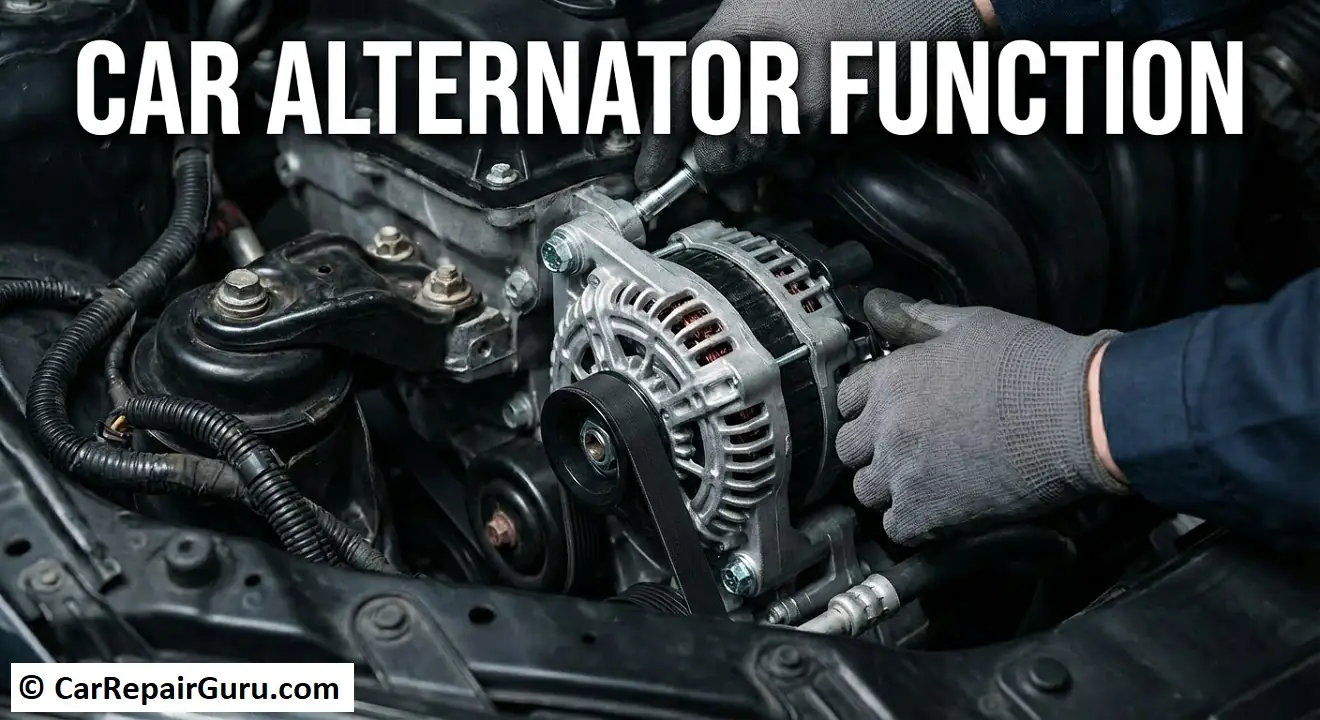
Ever wondered what really powers your car while you’re cruising down the highway with the radio on and the A/C blasting? Many people guess the battery, but that’s only half the story. The true workhorse of your vehicle’s electrical system is a component you’ve probably never thought much about: the alternator.
Think of the alternator as the unsung hero working tirelessly under the hood. It’s the heart of the car charging system, ensuring every electronic component has the steady stream of power it needs to operate. Without it, your car would run out of juice in a matter of minutes.
In this guide, we’ll demystify the car alternator function. We’ll break down exactly what it does, how it works with the battery, and the common warning signs that tell you it might be in trouble.
- What Does a Car Alternator Do? The Two Primary Jobs
- How a Car Alternator Works – From Mechanical to Electrical Energy
- The Serpentine Belt – The Power Connection
- Inside the Alternator – Key Parts and Their Functions
- Alternator vs. Battery – A Crucial Partnership
- 5 Common Signs of a Bad Alternator
- What to Do If You Suspect Alternator Failure
- How to Test Your Alternator (A Simple Voltmeter Test)
- Understanding Alternator Replacement Cost
- Final Thoughts – Your Car’s Unsung Powerhouse
- Frequently Asked Questions (FAQ) about Car Alternators
- How long should a car alternator last?
- Can I drive my car with a failing alternator?
- Will a bad alternator ruin a new battery?
- Is it the alternator or the battery that’s bad?
- Why does the battery light turn on for an alternator issue?
What Does a Car Alternator Do? The Two Primary Jobs
So, what does an alternator do, exactly? In simple terms, it’s your car’s personal power plant. Once your engine is running, the alternator takes over and performs two critical jobs simultaneously.
Job 1: It Powers All Your Car’s Electronics
From the moment the engine turns on, the alternator generates the electricity needed to run everything. This includes your headlights, dashboard lights, radio, power windows, windshield wipers, GPS, heated seats, and even the engine’s own control computer (ECU). It’s the reason your lights don’t dim and die as you drive.
Job 2: It Recharges Your Car Battery
Your car battery’s main job is to provide the massive jolt of energy needed to start the engine. That process drains a significant amount of its power. The alternator’s second crucial task is to replenish that lost energy, recharging the battery as you drive so it’s ready for the next time you need to start the car.
Think of the relationship like your smartphone and its wall charger. The battery (your phone) holds the charge, but the alternator (the charger) is what constantly generates and supplies the power to keep it topped up and functional.
How a Car Alternator Works – From Mechanical to Electrical Energy
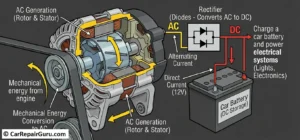
The magic of how an alternator works lies in a scientific principle called electromagnetic induction. But don’t worry, it’s simpler than it sounds. The alternator’s job is to convert the mechanical energy from the engine into usable electrical energy for your car.
Here’s a step-by-step look at the process.
The Serpentine Belt – The Power Connection
It all starts with the engine. When your car is running, the engine’s crankshaft spins rapidly. This spinning motion is transferred via a long, ribbed rubber belt—known as the serpentine belt or drive belt—to several components, including the alternator. The belt wraps around a pulley on the front of the alternator, causing it to spin at thousands of RPMs. This is the mechanical power source.
Inside the Alternator – Key Parts and Their Functions
Imagine cracking open the alternator’s metal case. Inside, a fascinating process is taking place thanks to these key alternator parts:
- Rotor & Stator: This is the core duo for electricity generation. The rotor is a spinning electromagnet that sits inside the stator, which is a stationary ring wrapped in a complex set of copper wire coils. As the serpentine belt spins the rotor, its moving magnetic field passes through the stator’s copper wires. This action excites the electrons in the copper and generates an electrical current. This initial current is AC (Alternating Current), which isn’t what your car uses.
- Diode Rectifier: Your car’s electronics and battery need DC (Direct Current). The rectifier acts as a one-way electrical gatekeeper. It takes the AC power generated by the rotor and stator and converts it into the smooth, usable DC power your vehicle needs.
- Voltage Regulator: This is the “brain” of the alternator. It’s a small but vital circuit that acts like a thermostat for electricity. It constantly monitors your car’s electrical needs and the battery’s charge level. If the battery is full and you’re not using many electronics, it tells the alternator to produce less power. If you turn on your high beams, A/C, and wipers, it signals the alternator to ramp up production. This prevents the system from being underpowered and, just as importantly, stops the battery from being overcharged, which can cause serious damage.
Alternator vs. Battery – A Crucial Partnership
This is one of the most common points of confusion for car owners. While they work together, the alternator vs battery roles are very different.
Think of it this way:
- The Battery is the Sprinter. It delivers a massive, short-term burst of power to crank the engine and get things started.
- The Alternator is the Marathon Runner. It provides a steady, long-term supply of power to keep everything running for the entire journey.
| Component | Primary Role | When It Works |
|---|---|---|
| Car Battery | Starts the engine, stores power | Primarily before the engine starts |
| Car Alternator | Generates power, recharges battery | Works continuously while the engine is running |
So, can a car run without an alternator? Yes, but only for a very short time. The car will run solely off the battery’s stored power. Depending on the battery’s condition and how many electronics you use, you might only have 10-20 minutes before the battery is completely drained and the car shuts down.
5 Common Signs of a Bad Alternator
Your car rarely keeps secrets when something is wrong. An alternator on its way out will almost always give you warning signs. If you notice any of the following, it’s time to get your car charging system checked.
- Dashboard Warning Light
This is the most obvious sign. Most cars have a warning light shaped like a battery, or one that says “ALT” or “GEN.” While it looks like a battery problem, this light is often triggered by the voltage regulator detecting an issue with the alternator’s output. - Dim or Flickering Headlights
Is your car’s lighting acting strange? Headlights that seem too dim, flicker, or get brighter when you rev the engine are a classic symptom. This happens because the failing alternator can’t produce a consistent, steady stream of voltage to power them properly. - A Weak or Dead Battery
If your alternator isn’t doing its job of recharging the battery, you’ll eventually find yourself with a car that won’t start. Many people replace their battery, only to have the new one die a few days later. The real culprit is often a bad alternator that’s letting the battery drain. - Strange Noises From Under the Hood
An alternator has several moving parts, including bearings that allow the rotor to spin freely. When these bearings wear out, they can produce a distinct grinding or whining noise that gets louder as the engine RPMs increase. - Electrical Failures or “Glitches”
Since the alternator powers all your electronics, its failure can cause bizarre issues. You might notice your power windows are sluggish, your radio randomly shuts off, your dashboard gauges go haywire, or your air conditioning blows less cold. These are signs there isn’t enough electricity to go around. If you are experiencing these ghosts in the machine, review our guide on common car electrical problems.
What to Do If You Suspect Alternator Failure
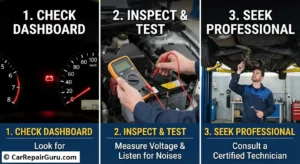
If you’re experiencing these symptoms, don’t ignore them. A failed alternator can leave you stranded.
How to Test Your Alternator (A Simple Voltmeter Test)
You can perform a basic check at home with a simple tool called a multimeter (or voltmeter).
- Safety First: Put your car in Park or Neutral with the emergency brake on.
- Check Battery Voltage (Engine Off): Set your multimeter to DC volts. Touch the red probe to the positive (+) battery terminal and the black probe to the negative (-) terminal. A fully charged battery should read around 12.6 volts.
- Check Alternator Voltage (Engine On): Start the car and let it run. Perform the same test. The reading should now jump up to somewhere between 13.8 and 14.4 volts. This higher reading shows the alternator is actively charging the battery.
- Analyze the Results: If the voltage stays the same or drops when the car is running, your alternator is likely not working correctly. If the voltage is excessively high (over 15 volts), the voltage regulator may have failed.
Disclaimer: If you’re not comfortable working around a running engine, it’s always best to have a professional mechanic diagnose the problem.
Understanding Alternator Replacement Cost
If your alternator has failed, replacement is almost always the best option. The cost can vary widely, typically ranging from $400 to $900 or more, depending on your vehicle’s make and model and local labor rates.
Final Thoughts – Your Car’s Unsung Powerhouse
The alternator is a testament to brilliant engineering—a compact, reliable generator that keeps your modern vehicle and all its technology humming along. It powers your drive and breathes life back into your battery, mile after mile.
Now that you understand the critical car alternator function, you’re better equipped to spot the warning signs of trouble. Don’t ignore dimming lights or strange noises. By paying attention to your car’s electrical health, you can address issues early and avoid the inconvenience of being stranded with a dead car. If you suspect a problem, have your charging system tested by a qualified mechanic to ensure many more miles of trouble-free driving.
Frequently Asked Questions (FAQ) about Car Alternators
How long should a car alternator last?
Most alternators are built to last for about 7 to 10 years, or between 100,000 to 150,000 miles. However, driving habits and the electrical demands of your vehicle can shorten this lifespan.
Can I drive my car with a failing alternator?
You can, but not for very long. The car will run solely on the battery’s power, which will drain quickly, leaving you stranded within a few minutes to half an hour depending on the battery’s charge.
Will a bad alternator ruin a new battery?
Yes, a faulty alternator is a common cause of premature battery failure. Since it cannot recharge the battery, the new battery will be drained completely, which can permanently damage its cells.
Is it the alternator or the battery that’s bad?
A simple test is to jump-start the car. If it starts but dies immediately after removing the jumper cables, the alternator is almost certainly the problem. A bad battery typically just won’t start at all.
Why does the battery light turn on for an alternator issue?
The battery warning light indicates a problem within the entire charging system, not just the battery itself. It illuminates when the system’s voltage drops below a certain level, which is a classic sign of a failing alternator.
About the Author