Marco
Marco 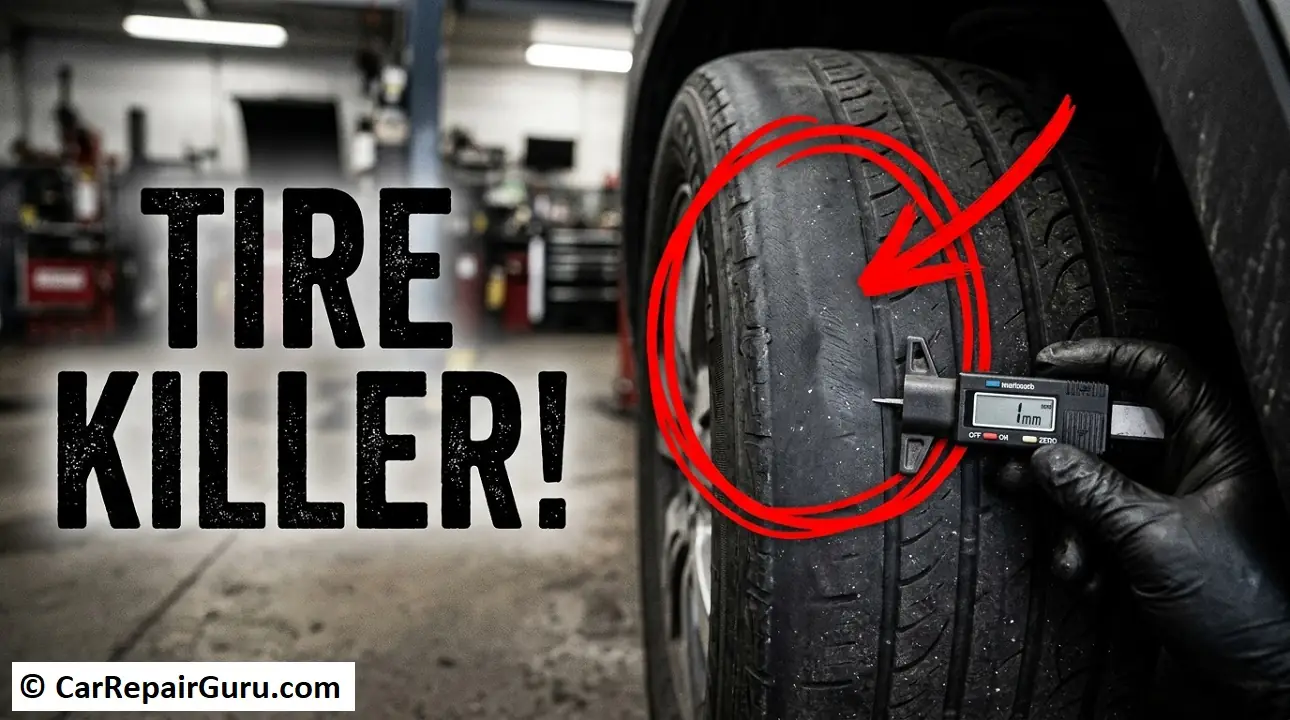
You know the feeling. You’re driving down the highway, and you feel a slight, nagging vibration in the steering wheel. Or maybe you’ve noticed your car pulling to the left, fighting you every time you try to drive straight. You park the car, look at your wheels, and there it is: one part of the tire is bald, while the rest looks brand new.
Uneven tire wear is one of the most frustrating issues a car owner faces. It’s not just annoying; it’s a silent wallet-killer. Tires are expensive, and if they aren’t wearing down evenly, you’re throwing money away by replacing them thousands of miles earlier than necessary. More importantly, it’s a safety hazard. Tires with uneven tread can’t grip the road properly, increasing your risk of hydroplaning or suffering a blowout.
The good news? Your tires are trying to talk to you. The specific way they are wearing down is actually a code that tells you exactly what is wrong with your vehicle.
Whether you’re dealing with tire cupping, smooth edges, or jagged tread blocks, this guide will help you decode the damage, understand the root mechanical causes, and walk you through the steps for fixing uneven tire wear for good.
- The First Step – Visual Inspection (How to Spot the Issue)
- 5 Common Uneven Tire Wear Patterns (and How to Fix Them)
- 1. Center Wear (The Balloon Effect)
- 2. Edge/Shoulder Wear (The Sag)
- 3. Inner or Outer Edge Wear (Camber Issues)
- 4. Feathering or Scuffing (Toe Issues)
- 5. Cupping or Scalloping (The Bouncing Tire)
- The Hidden Costs of Ignoring Uneven Wear
- DIY Checks vs. Professional Repair – When to Visit the Shop
- Can You Reverse Uneven Tire Wear?
- Essential Maintenance to Prevent Future Wear
- 1. Routine Tire Rotation
- 2. The Monthly Pressure Check
- 3. Regular Alignment Checks
- 4. Listen to Your Suspension
- Final Thoughts
- Frequently Asked Questions (FAQ)
The First Step – Visual Inspection (How to Spot the Issue)
Before we jump into the mechanics, you need to get up close and personal with your tires. You don’t need to be a mechanic to do this, and you don’t need a fancy lift.
Park your car on a flat surface and turn your steering wheel all the way to one side. This exposes the tread of the front tires so you can inspect the entire width, from the inner edge to the outer edge.
What you are looking for:
- The Penny Test: Take a standard U.S. penny and insert it into the tread grooves with Lincoln’s head upside down. If you can see all of Lincoln’s head in one spot, but his hair is covered in another spot, you have uneven wear.
- The Touch Test: Run your hand (carefully) along the surface of the tire. Does it feel smooth? Does it feel jagged, like the teeth of a saw? Does it feel bumpy or wavy?
- Visible Cords: If you see any steel wires or fabric poking through the rubber, stop reading and go to a tire shop immediately. That tire is a ticking time bomb.
Once you’ve looked, compare what you see to the five common patterns below.
5 Common Uneven Tire Wear Patterns (and How to Fix Them)
Fixing the tire isn’t just about replacing rubber; it’s about fixing the vehicle attached to the rubber. If you put new tires on a car with mechanical issues, you’ll just ruin the new tires, too.
Here are the most common tire wear patterns, what they mean, and the solution for each.
1. Center Wear (The Balloon Effect)
The Appearance: The tread right in the middle of the tire is worn down smooth, but the shoulders (the edges) still have plenty of tread depth left.
The Cause: This is a classic case of over-inflation. When you put too much air in a tire, it bulges out in the center like a balloon. The contact patch – the part of the tire touching the road – shrinks to just that center strip. The edges of the tire aren’t carrying their fair share of the vehicle’s load.
The Fix:
- Immediate: Perform a tire pressure check. If you are unsure how to adjust the air level safely, you can learn more about how to inflate car tires to the proper specifications. Do not look at the “Max PSI” number printed on the sidewall of the tire; that is the maximum the tire can hold before exploding, not the driving pressure.
- Corrective: Open your driver’s side door and look for a sticker in the door jamb. It will list the manufacturer’s recommended PSI (usually between 30 and 35 PSI for passenger cars). Let air out until you match that number.
2. Edge/Shoulder Wear (The Sag)
The Appearance: The inner and outer edges of the tire are worn down, but the center of the tire looks fine.
The Cause: This is the opposite of center wear. It indicates under-inflation. When a tire is low on air, it can’t support the weight of the car properly. The center of the tire sags inward, forcing the brunt of the weight onto the shoulders (edges) of the tire. It’s like walking on the sides of your feet.
The Fix:
- Immediate: Inflate your tires to the recommended PSI found in the door jamb.
- Investigation: Under-inflation is often caused by neglect (air escapes naturally over time), but it can also be a slow leak. If you fill it up and it’s low again in a week, have a shop check for a nail or a leaky valve stem.
3. Inner or Outer Edge Wear (Camber Issues)
The Appearance: This is one of the most common and destructive types. One side of the tire is perfectly fine, but the other side (usually the inner tire wear) is completely bald, sometimes down to the cords.
The Cause: This is a tire alignment symptom related to Camber. Camber refers to the vertical tilt of the wheel.
- Negative Camber: The top of the tires tilt inward toward the engine. This puts all the pressure on the inner edge.
- Positive Camber: The top of the tires tilt outward. This wears the outer edge.
- Note: While alignment is the usual suspect, worn ball joints or collapsed control arm bushings can also cause the wheel to tilt, leading to this wear.
The Fix:
You cannot fix this with air pressure. You need a professional wheel alignment. A technician will adjust the suspension angles to make the tire stand straight up (per factory specs). If the technician can’t get it into alignment, it usually means a suspension part (like a ball joint) is bent or broken and needs replacing.
4. Feathering or Scuffing (Toe Issues)
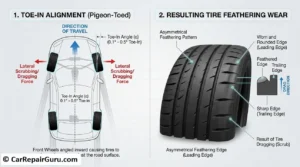
The Appearance: This one is tricky to see, but easy to feel. Run your hand across the tread blocks. If they feel smooth when you rub one way, but sharp or jagged (like a cheese grater) when you rub the other way, that is tire feathering.
The Cause: This is caused by Toe alignment. Imagine looking at your feet. If you turn your toes in (pigeon-toed), that’s “Toe-In.” If you turn them out, that’s “Toe-Out.”
When your car’s tires are toed in or out excessively, they aren’t rolling straight; they are literally being dragged sideways down the road while they roll. This scuffs the rubber off the tread blocks at an angle.
The Fix:
This is strictly an alignment fix. The tie rods (which steer the wheels) need to be adjusted to bring the wheels parallel to each other.
5. Cupping or Scalloping (The Bouncing Tire)
The Appearance: This looks like someone took an ice cream scoop and gouged out random divots of rubber around the tire. It creates a wavy, dipping surface.
The Cause: Tire cupping is almost always a suspension problem, not an alignment problem. Your shock absorbers or struts are designed to keep the tire pressed firmly against the road. When shocks wear out, the tire bounces uncontrollably after every bump. Every time it lands, it scuffs a spot on the tire. It can also be caused by tires that are severely out of balance.
The Fix:
- Suspension: You likely need to replace your shocks or struts.
- Balancing: Once the suspension is fixed, have the tire and wheel assembly balanced.
- Warning: Cupped tires are usually incredibly noisy, creating a loud roaring or growling sound while driving.
The Hidden Costs of Ignoring Uneven Wear
You might look at a bald strip on your tire and think, “I’ll just drive on it for another month and save the money.” But here is the reality: ignoring uneven tire wear patterns actually costs you more money every time you turn the key, even before you buy new tires.
There are three silent ways uneven wear drains your wallet and compromises your safety:
- Reduced Fuel Economy: When tires wear unevenly – especially due to under-inflation or misalignment (Toe issues) – they create excessive “rolling resistance.” Your engine has to work harder to push the car forward because the tires are literally dragging against the asphalt rather than rolling smoothly. This can drop your gas mileage by anywhere from 3% to 10%.
- Strain on Suspension Components: A tire that is cupped or out of balance vibrates. You might get used to the buzzing in your seat, but your car’s wheel bearings, tie rods, and steering rack feel every single impact. Prolonged driving on damaged tires can rattle these expensive parts loose, turning a $200 tire problem into a $1,000 suspension repair.
- Compromised Safety (Hydroplaning & Stopping): The tread grooves on your tire are designed to channel water away so the rubber grips the road. If you have inner tire wear or smooth patches, water gets trapped under the tire. This leads to hydroplaning, where your car skates uncontrollably on top of the water. Furthermore, uneven tread significantly increases your braking distance, meaning you might not stop in time during an emergency.
DIY Checks vs. Professional Repair – When to Visit the Shop
When you notice your tires acting up, it’s tough to know if this is a Saturday morning DIY project or a “drop it off at the mechanic” situation. Here is how to draw the line.
What You Can Fix at Home (DIY):
- Air Pressure Issues: If you identify Center Wear (Over-inflation) or Edge Wear (Under-inflation), this is 100% fixable in your driveway. All you need is a reliable tire pressure gauge and an air compressor (or a trip to the gas station air pump). Adjust the pressure to the door jamb specs, reset your Tire Pressure Monitoring System (TPMS) light if necessary, and monitor it for a few days.
- Visual Monitoring: You can and should perform the “Penny Test” and visual inspections yourself. You can also look for nails or screws in the tread.
When You Need a Professional:
- Alignment Issues (Camber/Toe): You cannot eyeball a wheel alignment. Adjusting the angles of your wheels requires a computerized alignment machine that measures to the fraction of a degree. If you have feathering or one-sided wear, you need a shop.
- Suspension Repairs: If you have tire cupping, replacing struts or shocks is a complex job that often requires spring compressors and specialized tools. This is best left to certified mechanics.
- Mounting and Balancing: If a tire is out of balance (causing vibration), it must be removed from the car and spun on a high-speed balancing machine to identify where to place wheel weights. This is not something you can do at home.
Can You Reverse Uneven Tire Wear?
This is the question every driver asks: “Can I save these tires?”
Here is the hard truth: You cannot “grow back” rubber. Once a wear pattern is established, the damage is permanent.
However, the answer depends on the severity:
- If the wear is minor: If you catch the issue early (e.g., slight feathering or minor edge wear), you can prolong the tire’s life. Fix the mechanical problem (alignment or pressure), and then rotate the tires. Moving a tire with edge wear to the rear axle often helps it wear more evenly over time as it tracks differently than it did on the front.
- If the wear is severe: If you can see “wear bars” (smooth rubber connecting the treads), steel belts, or if the cupping is so deep the car vibrates, the tire is toast. You must replace it. Driving on it is unsafe.
Essential Maintenance to Prevent Future Wear
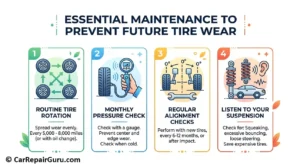
Once you’ve gone through the hassle of fixing uneven tire wear or buying a new set of rubber, you want to make sure it doesn’t happen again. Tire maintenance is much cheaper than tire replacement.
Here is your prevention checklist:
1. Routine Tire Rotation
Front tires and rear tires do different jobs. On most cars, the front tires handle the weight of the engine and all the steering forces, causing them to wear the edges faster. By performing a tire rotation every 5,000 to 8,000 miles (or every time you get an oil change), you spread that wear out evenly across all four tires.
2. The Monthly Pressure Check
Tires lose about 1 PSI per month naturally, and more when the temperature drops in winter. Don’t wait for the warning light on your dashboard. Buy a cheap digital gauge and check your pressure once a month. This prevents the Center and Edge wear we discussed earlier.
3. Regular Alignment Checks
You don’t need an alignment every month, but you should check it:
- Every time you buy new tires.
- Every 6 to 12 months as maintenance.
- Immediately after hitting a large pothole or curb.
4. Listen to Your Suspension
If your car starts squeaking over bumps, bouncing excessively, or the steering feels “loose,” get your suspension checked. Catching a bad ball joint early can save you from ruining a $200 tire.
Final Thoughts
Your tires are the only thing connecting your vehicle to the road. When you see uneven wear, don’t ignore it. It’s a symptom of a larger problem, whether that’s a simple lack of air, a pothole-induced alignment issue, or worn-out shocks.
By identifying these patterns early, you can stop the damage in its tracks. Fixing uneven tire wear starts with a simple visual check, but it ends with a safer, smoother ride and more money in your pocket.
Go out to your driveway, grab a penny, and check your tires today. If you see something uneven, book that alignment or grab the air hose – your car will thank you.
Frequently Asked Questions (FAQ)
Is it safe to drive on tires with uneven wear?
It depends on how bad it is. Minor unevenness is annoying but generally safe. However, if the wear has exposed the internal structure (wires/cords) or if the tread depth is below 2/32 of an inch, it is illegal and dangerous. Deep tire cupping can also cause a loss of traction during braking.
Does uneven tire wear always mean I need an alignment?
No. While alignment causes “camber” and “toe” wear, issues like center wear or edge wear are usually just air pressure problems. Always check your tire pressure first – it’s the free fix!
Can bad brakes cause uneven tire wear?
Occasionally, yes. If a brake caliper seizes (locks up), it can cause the tire to drag or lock up momentarily, creating a flat spot on one section of the tire.
How much does it cost to fix uneven tire wear?
The diagnosis (visual check) is free.
- Air Pressure: Free (or a few quarters at a pump).
- Alignment: $100–$150.
- Suspension Repair: $300–$600+ depending on the part.
- New Tires: $400–$1,000+.
This highlights why the $100 alignment is a smart investment to save the $800 set of tires.
About the Author