Marco Riley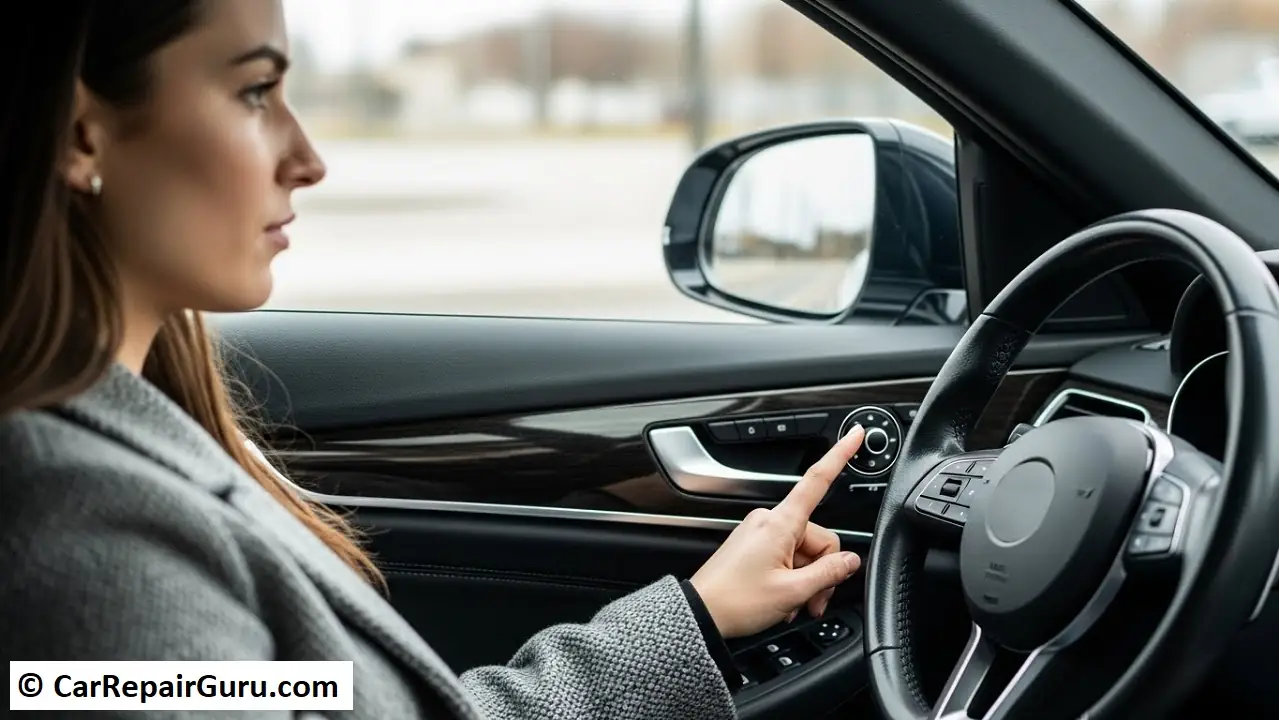
Let’s be honest: how were you taught to adjust your car mirrors?
If you’re like most of us, the answer is probably something like, “Make sure you can see a little slice of your own car in the side mirrors.” For decades, this was the standard advice passed down from parents to new drivers. It feels intuitive, right? It helps you know where your car is in relation to what you see in the mirror.
Here’s the thing: that advice is outdated, and it’s creating massive, dangerous blind spots on either side of your vehicle.
The primary goal of your mirrors isn’t to see your own car—it’s to see the space where other cars can hide. By learning the correct mirror position, you can create a seamless, panoramic view around your vehicle, virtually eliminating those treacherous blind spots.
This guide will walk you through the modern, safety-expert-approved method for adjusting car mirrors. It’s a simple change that will fundamentally improve your awareness and make you a safer, more confident driver.
- First Things First – Lock In Your Driving Position
- The Step-by-Step Guide to a Blind-Spot-Free View – The BGE Method
- Step 1 – The Interior Rearview Mirror Adjustment
- Step 2 – Adjusting the Driver’s Side Mirror (Left Side)
- Step 3 – Adjusting the Passenger’s Side Mirror (Right Side)
- Did It Work? The Simple ‘Passing Car’ Blind Spot Test
- Common Mirror Adjustment Mistakes (and Why the Old Way Is Risky)
- Special Considerations & Advanced Tips
- Conclusion – Drive with Confidence and Clarity
- Frequently Asked Questions (FAQ)
- How often should I adjust my car mirrors?
- Why can’t I see my own car in the side mirrors?
- Is this mirror setting method safe for all cars?
- What if I use small, stick-on blind spot mirrors?
- Do I still need this with a blind spot monitoring system?
First Things First – Lock In Your Driving Position
Before you even think about touching your mirrors, you need to get your seat right. Your mirrors are only correct for one specific seating position—yours. If you adjust them and then change your seat, you’ve undone all your hard work.
Take 30 seconds to ensure you’re seated correctly. This is the foundation for everything else.
- Adjust for Reach: Sit down and slide your seat forward or backward so you can comfortably press the brake pedal all the way to the floor without your leg being completely straight. Your knee should still have a slight bend.
- Set Your Backrest: Sit upright with your back and shoulders firmly against the seat. Avoid a deep recline. An angle of about 100-110 degrees is ideal for both comfort and control. You should be able to rest your wrists on top of the steering wheel without leaning forward.
- Position Your Headrest: Adjust the headrest so the middle of it is level with the top of your ears. This is crucial for preventing whiplash in a collision.
Once you’re comfortable and in a position you can consistently replicate, don’t change it. Now, you’re ready to adjust your car mirrors.
The Step-by-Step Guide to a Blind-Spot-Free View – The BGE Method
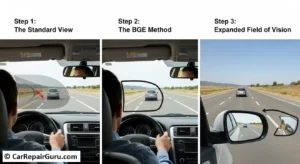
We’re going to use a technique known as the BGE (Blind spot & Glare Elimination) setting. This method is widely recommended by safety organizations like AAA because it focuses on extending your field of view outward, creating overlapping zones of visibility that cover your blind spots.
Step 1 – The Interior Rearview Mirror Adjustment
This one is the easiest. From your locked-in driving position, adjust your interior rearview mirror so you can see the entire rear window. You should be able to frame the back windshield perfectly without having to tilt your head or crane your neck.
- Pro-Tip: Notice that little tab at the bottom of the mirror? That’s for nighttime driving. If a car’s headlights behind you are creating a glare, flip that tab to dim the reflection. Many modern cars have auto-dimming mirrors that do this for you.
Step 2 – Adjusting the Driver’s Side Mirror (Left Side)
This is where we break from tradition. The key to adjusting side mirrors to eliminate blind spots is to move your head to a reference point.
- While in your driver’s seat, lean your head to the left until it touches the driver’s side window.
- From this leaned position, adjust the mirror outwards until you can just barely see the rear corner of your car. It should only be a tiny sliver at the very edge of the mirror.
- Now, sit back up straight into your normal driving position.
What do you see? The side of your car should have completely vanished from the mirror. Instead, you now have a clear view of the lane next to you—exactly where a car in your blind spot would be.
Step 3 – Adjusting the Passenger’s Side Mirror (Right Side)
We’ll use the same principle here, but with a different reference point.
- While in your driver’s seat, lean your head to the right so it’s roughly over the center console or gear shifter.
- From this leaned position, adjust the passenger’s side mirror outwards until you can, once again, just barely see the rear corner of your own car.
- Return to your normal driving position.
Just like the driver’s side, your car should no longer be visible in the passenger’s mirror. You’ve now pointed that mirror into the right-side blind spot.
Did It Work? The Simple ‘Passing Car’ Blind Spot Test
So, you’ve followed the steps. How do you know you have the correct mirror position? The proof is in how traffic flows around you. You can perform this car mirror blind spot test safely while parked in a large lot with a friend, or by paying close attention the next time you’re on a multi-lane road.
Here’s what you should see:
- Watch a car as it approaches from behind in your rearview mirror.
- As it begins to move out of your rearview mirror, it should immediately and seamlessly appear in your side mirror. There should be no gap where the car disappears.
- As the car begins to leave your side mirror, you should already be able to see the front of it in your peripheral vision.
If this “handoff” from one mirror to the next is seamless, congratulations! You have successfully performed a proper blind spot mirror adjustment.
Common Mirror Adjustment Mistakes (and Why the Old Way Is Risky)
- The Big Mistake: Seeing Your Own Car. The traditional method of keeping a slice of your car in view creates a redundant overlap. Your side mirrors show you what your rearview mirror already sees, while leaving a huge, dangerous void right next to your rear bumper. The BGE method eliminates this redundancy.
- Forgetting to Re-adjust: If someone else drives your car—a partner, a friend, a valet—your mirrors are now set for them, not you. Make it a habit to check your mirrors every single time you get in the car.
- Adjusting While Driving: Never try to fine-tune your mirrors while the car is in motion. Pull over to a safe location to make any changes.
Special Considerations & Advanced Tips
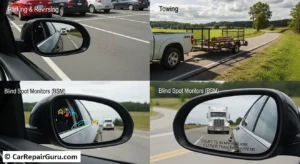
- Parking & Reversing: The one time seeing your own car is useful is when parking. It’s perfectly fine to temporarily tilt your passenger mirror down to see the curb while parallel parking. Many modern cars have a feature that does this automatically when you shift into reverse. Just remember to tilt it back up afterward!
- Towing a Trailer: If you’re towing, you’ll need special towing mirrors that extend farther out. The adjustment principle is the same: set them so you can see the lane next to you and the entire length of your trailer.
- What About Blind Spot Monitors (BSM)? Those little warning lights on your mirrors are fantastic safety aids, but they are not a replacement for properly adjusted mirrors. Technology can fail. Your eyes, backed by a clear field of view, are your primary line of defense.
- “Objects in Mirror Are Closer Than They Appear”: You’ve seen this warning on your passenger mirror. That’s because it’s a convex mirror (curved outward) to give you a wider viewing angle. Your driver’s side mirror is typically a flat mirror, showing a true-to-life distance. Be mindful of this difference when judging gaps.
Conclusion – Drive with Confidence and Clarity
It might feel strange at first to not see the familiar flank of your own car in your side mirrors. But after a few drives, you’ll notice a world of difference. Lane changes will feel more certain. You’ll have a far better sense of the traffic around you.
Taking two minutes to adjust your car mirrors with this method is one of the single most effective things you can do to improve your safety on the road. So before your next trip, take a moment to set them right. Drive with a newfound confidence and a clearer, safer view of the world around you.
Frequently Asked Questions (FAQ)
How often should I adjust my car mirrors?
You should check your mirrors before every drive to ensure they haven’t been bumped. Always perform a full readjustment if someone else has driven your car or if you’ve changed your seat position.
Why can’t I see my own car in the side mirrors?
Seeing your own car is redundant and creates a dangerous blind spot in the lane next to you. By adjusting the mirrors outward, you replace that useless view with a critical one of the adjacent traffic.
Is this mirror setting method safe for all cars?
Yes, the BGE method is a universal principle that works on nearly all passenger vehicles, from compact sedans to large SUVs. Maximizing your field of vision is a key safety practice in any car.
What if I use small, stick-on blind spot mirrors?
Stick-on mirrors are a great supplement, but they aren’t a replacement for proper setup. You should set your main factory mirrors using this method first to do most of the work.
Do I still need this with a blind spot monitoring system?
Absolutely. Electronic systems are fantastic driver aids, but they can fail and should not be your only line of defense. Properly adjusted mirrors provide a reliable and direct view of your surroundings.
About the Author