Marco
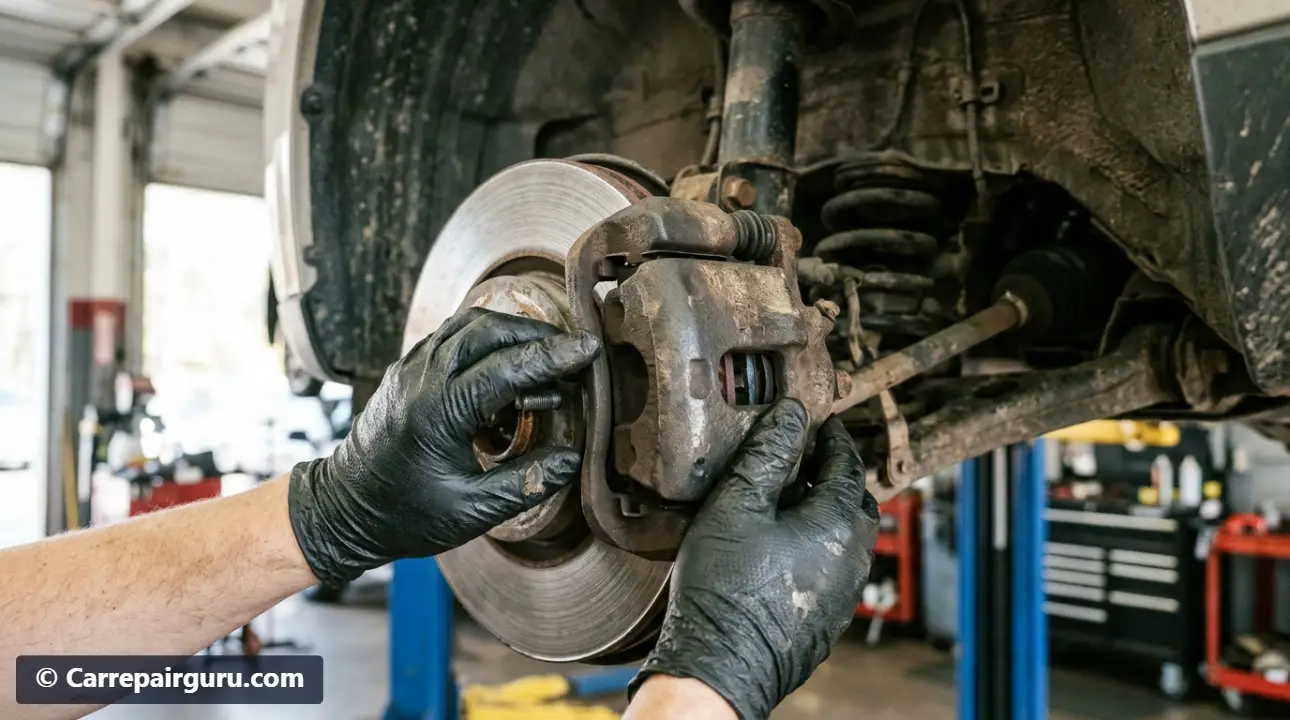
Brake calipers are essential parts of a vehicle’s disc braking system. They apply pressure to the brake pads, forcing them against the rotating brake rotors to slow down or stop the wheels. Without properly functioning calipers, your vehicle may not brake evenly or release the brakes as it should.
Although brake calipers are designed to last for many years, their pistons, seals, sliding pins, and other components can wear out or become damaged. Corrosion, moisture, road debris, and excessive heat can also affect their operation.
Understanding how brake calipers work can help you recognize potential problems before they lead to more serious brake damage. In this guide, you’ll learn about the different caliper types, their main components, common failure symptoms, repair options, and what to consider when replacing one.
- What Is a Brake Caliper?
- How Do Brake Calipers Work?
- What Are the Main Parts of a Brake Caliper?
- Caliper Housing
- Pistons
- Piston Seals
- Dust Boots
- Slide Pins and Guide Bushings
- Brake Pad Retaining Hardware
- Bleeder Valve
- What Are the Different Types of Brake Calipers?
- Floating or Sliding Brake Calipers
- Fixed Brake Calipers
- Single-Piston vs. Multi-Piston Calipers
- What Are the Signs of a Bad Brake Caliper?
- Vehicle Pulling to One Side
- Uneven Brake Pad Wear
- Brake Fluid Leaking Around the Caliper
- One Wheel Getting Excessively Hot
- Burning Smell After Driving
- Caliper Sticking or Failing to Release
- Reduced Braking Performance
- What Causes Brake Calipers to Fail?
- Corrosion and Rust
- Seized Slide Pins
- Damaged Piston Seals
- Torn or Damaged Dust Boots
- Contaminated or Incorrect Brake Fluid
- Excessive Heat
- Can a Brake Caliper Be Rebuilt or Does It Need Replacement?
- When Rebuilding a Brake Caliper Makes Sense
- When Replacing the Entire Brake Caliper Is Better
- Should You Replace One Brake Caliper or Both?
- How Much Does Brake Caliper Replacement Cost?
- Brake Caliper Parts Cost
- Labor Cost
- Additional Costs to Consider
- Can You Replace a Brake Caliper Yourself?
- Tools and Equipment Needed
- Basic Brake Caliper Replacement Process
- What Is an Electronic Parking Brake (EPB) Caliper?
- How Can You Make Brake Calipers Last Longer?
- Final Thoughts on Brake Calipers
- Frequently Asked Questions
- How long do brake calipers usually last?
- Can you drive with a bad brake caliper?
- Is it safe to drive with a sticking brake caliper?
- Can a brake caliper cause uneven brake pad wear?
- Should brake calipers be replaced in pairs?
- Can a brake caliper be repaired instead of replaced?
- Do brake calipers need to be lubricated?
- How much does it cost to replace a brake caliper?
What Is a Brake Caliper?
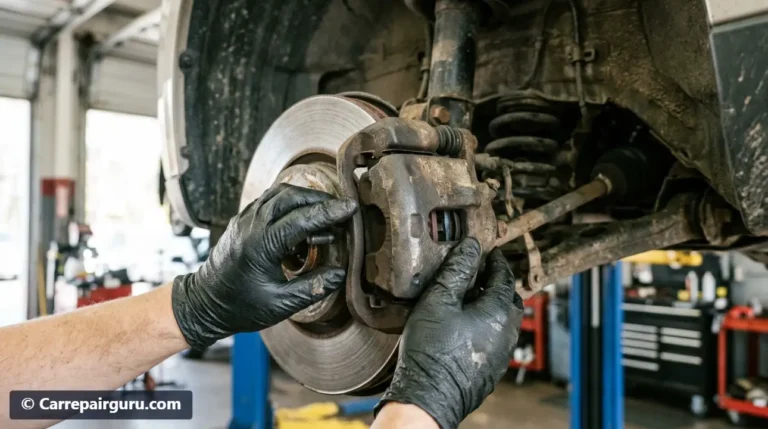
A brake caliper is a mechanical and hydraulic component that fits around part of a brake rotor. It holds the brake pads in position and uses hydraulic pressure to push them against the rotor when you press the brake pedal.
Most vehicles with disc brakes have a caliper at each wheel equipped with a disc brake system. The caliper is attached to a mounting bracket or steering knuckle, depending on its design.
Its main job is to convert hydraulic pressure from the brake fluid into mechanical force. This force pushes the brake pads against the rotor, creating friction that slows the wheel.
A brake caliper works together with several other braking components:
- Brake pads: Create friction against the rotor to slow the vehicle.
- Brake rotors: Rotate with the wheels and provide the surface against which the pads press.
- Brake fluid: Transfers hydraulic pressure from the master cylinder to the caliper.
- Brake hoses and lines: Carry brake fluid to the caliper.
- Caliper pistons: Apply pressure to the brake pads.
The caliper is therefore more than just a housing around the brake pads. It is a key part of the system that controls how braking force is applied at each wheel.
How Do Brake Calipers Work?
Brake calipers operate through hydraulic pressure. When you press the brake pedal, the master cylinder pressurizes the brake fluid and sends it through the brake lines toward the calipers.
Here is what happens during a normal braking cycle.
1. You press the brake pedal
The brake pedal activates the master cylinder, which increases pressure in the brake fluid.
2. Hydraulic pressure reaches the caliper
The pressurized fluid enters the caliper and pushes its piston or pistons outward.
3. The brake pads contact the rotor
The pistons push the brake pads against the rotor. In a floating caliper, the caliper body also slides on its guide pins to apply pressure to the opposite pad.
4. Friction slows the wheel
The contact between the brake pads and rotor creates friction, reducing the rotor’s rotational speed and slowing the vehicle.
5. You release the brake pedal
When you release the pedal, hydraulic pressure drops. The piston seals allow a small amount of piston rollback, reducing pressure on the pads so the rotor can rotate freely.
The pads may remain very close to the rotor, but they should not continue dragging heavily against it.
The basic principle is the same across most hydraulic disc brake systems, although the exact design varies between vehicles and caliper types.
What Are the Main Parts of a Brake Caliper?
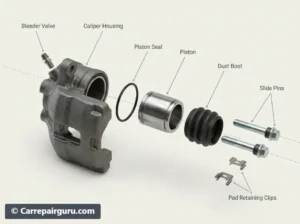
A brake caliper contains several components that must work together to apply and release braking pressure correctly.
Caliper Housing
The caliper housing is the main body that contains the pistons and supports the brake pads. It must withstand high hydraulic pressure, braking forces, and heat generated during braking.
Caliper housings are commonly made from cast iron or aluminum alloys, depending on the vehicle and brake design.
Pistons
Caliper pistons receive hydraulic pressure from the brake fluid and push the brake pads against the rotor.
Some calipers have one piston, while others use multiple pistons. The number and arrangement depend on the caliper design and the braking requirements of the vehicle.
Pistons must move smoothly inside their bores. Corrosion, dirt, or damaged seals can cause them to stick.
Piston Seals
Piston seals sit between the piston and the caliper bore. They prevent brake fluid from leaking and help the piston retract slightly when hydraulic pressure is released.
A damaged seal can cause brake fluid leakage or interfere with normal piston movement.
Dust Boots
Dust boots protect the piston area from moisture, dirt, and road debris. They help prevent corrosion that could eventually cause the piston to stick.
A torn or damaged boot should not be ignored because contaminants can enter the piston area and damage the caliper.
Slide Pins and Guide Bushings
Floating calipers use slide pins or guide bolts that allow the caliper body to move sideways as the brakes are applied.
These parts need to move freely. If they become corroded, contaminated, or seized, the caliper may not apply pressure evenly or release properly.
Brake Pad Retaining Hardware
Clips, springs, and other retaining hardware hold the brake pads in position and help control unwanted movement and noise.
Worn, damaged, or incorrectly installed hardware can contribute to brake noise and uneven pad movement.
Bleeder Valve
The bleeder valve provides an opening through which air can be removed from the caliper and brake hydraulic system during bleeding.
It must remain sealed when closed. A damaged or leaking bleeder valve can cause brake fluid loss and introduce air into the system.
What Are the Different Types of Brake Calipers?
Brake calipers come in different designs. The two main types used in disc braking systems are floating calipers and fixed calipers.
Floating or Sliding Brake Calipers
A floating caliper, also called a sliding caliper, has pistons on only one side of the brake rotor. The caliper body moves sideways on guide pins or sliding surfaces.
When hydraulic pressure pushes the piston against the inner brake pad, the reaction force moves the caliper body in the opposite direction. This movement brings the outer pad against the other side of the rotor.
Most conventional floating calipers use one piston, although some designs use more.
Advantages of floating calipers include:
- Relatively simple construction.
- Lower manufacturing cost than many fixed-caliper designs.
- Compact packaging.
- Suitable for a wide range of everyday vehicles.
Potential limitations include:
- Dependence on freely moving guide pins.
- Guide-pin corrosion can affect braking performance.
- Seized sliding components can contribute to uneven pad wear.
Floating calipers are widely used on passenger vehicles because they offer a practical balance of cost, size, and braking performance.
Fixed Brake Calipers
A fixed brake caliper is securely mounted and does not slide during normal braking. Instead, it contains pistons on both sides of the rotor.
When hydraulic pressure enters the caliper, the pistons push the brake pads inward from both sides, creating friction against the rotor.
Fixed calipers often use multiple pistons, especially on performance vehicles. However, the number of pistons alone does not determine how well a braking system performs.
Advantages of fixed calipers include:
- Rigid construction.
- Potential for strong and consistent pad application.
- Multiple-piston configurations.
- Common use in performance and high-performance braking systems.
Potential limitations include:
- More complex construction.
- Higher manufacturing and replacement costs in many applications.
- Greater packaging and clearance requirements.
Fixed calipers are commonly found on sports cars and vehicles designed for demanding braking conditions, although their use is not limited to those vehicles.
Single-Piston vs. Multi-Piston Calipers
The number of pistons in a caliper affects how force is distributed across the brake pads.
A single-piston caliper uses one piston to apply pressure to the pad. It is commonly found in floating caliper designs.
Multi-piston calipers use two or more pistons. These may be arranged on one side of the rotor or on both sides, depending on the design.
Multiple pistons can help distribute pressure across a larger pad surface. Different piston sizes may also be used to manage pad pressure and wear.
However, a six-piston caliper is not automatically better than a four-piston caliper. Overall braking performance depends on the complete braking system, including rotor size, pad material, hydraulic design, vehicle weight, tires, and brake balance.
For more technical details, see Brembo’s explanation of brake caliper technology and operation.
What Are the Signs of a Bad Brake Caliper?
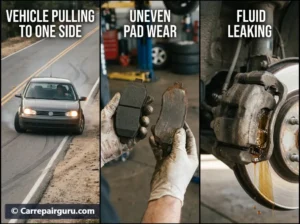
A faulty brake caliper can affect how your vehicle slows down. Some problems develop gradually, while others can cause noticeable changes in braking performance.
Here are common signs that a caliper may need inspection.
Vehicle Pulling to One Side
If your vehicle pulls to one side when braking, one caliper may not be applying or releasing braking pressure correctly.
For example, a sticking caliper may cause one wheel to brake harder than the other. However, pulling can also result from tire problems, suspension faults, alignment issues, or other brake-system problems.
Read our guide to why a car pulls to one side to understand the other possible causes.
Uneven Brake Pad Wear
Brake pads should wear relatively evenly across the same axle, although some variation can occur.
If one pad is significantly thinner than the other, the caliper or its sliding mechanism may not be operating correctly.
For example, seized guide pins on a floating caliper can prevent the caliper from moving freely, contributing to uneven pad wear.
Brake Fluid Leaking Around the Caliper
Brake fluid around the caliper can indicate a damaged piston seal, loose bleeder valve, or another hydraulic connection problem.
A brake fluid leak should always be treated seriously. Low fluid levels can affect braking performance and may allow air to enter the hydraulic system.
Do not continue driving a vehicle with a suspected brake fluid leak until the problem has been inspected and repaired.
One Wheel Getting Excessively Hot
A sticking caliper may keep the brake pads in contact with the rotor even after you release the brake pedal.
This creates continuous friction and heat. You may notice that one wheel area becomes much hotter than the others after driving.
Do not touch the rotor or caliper to check its temperature. Brake components can become hot enough to cause serious burns.
Burning Smell After Driving
A strong burning smell near one wheel can indicate that a brake is overheating.
A sticking piston, seized guide pins, or another brake-related fault may prevent the pads from releasing properly.
The smell may become more noticeable after driving or when stopping the vehicle. If you notice smoke, a strong burning smell, or unusual heat from a wheel, stop somewhere safe and arrange an inspection.
Caliper Sticking or Failing to Release
A caliper should apply braking pressure when needed and release it when you take your foot off the pedal.
If the piston or sliding mechanism becomes stuck, the brake may continue dragging against the rotor.
This can increase heat, accelerate pad and rotor wear, and make the vehicle harder to drive.
Reduced Braking Performance
A faulty caliper can contribute to uneven braking, reduced stopping performance, or an abnormal brake pedal feel.
However, these symptoms can also result from air in the brake lines, worn pads, damaged rotors, brake fluid problems, or master cylinder faults.
Any noticeable change in braking performance should be inspected promptly.
What Causes Brake Calipers to Fail?
Brake calipers are exposed to heat, moisture, road salt, dirt, and repeated mechanical stress. Over time, these conditions can damage their components.
Corrosion and Rust
Moisture and road salt can cause corrosion on caliper components, particularly in areas where winter road treatments are common.
Corrosion around the piston or inside the caliper bore can interfere with piston movement. It can also affect sliding surfaces and guide pins.
If corrosion becomes severe, cleaning alone may not restore reliable operation.
Seized Slide Pins
Floating calipers depend on guide pins to move correctly.
When these pins become corroded, dirty, or improperly lubricated, the caliper may not slide as designed.
This can cause uneven brake pad wear, dragging brakes, and excess heat.
Damaged Piston Seals
Piston seals prevent brake fluid from escaping and help control piston movement.
Over time, seals can deteriorate because of heat, age, contamination, or the use of incompatible fluids and materials.
A damaged seal may allow brake fluid to leak or cause problems with normal caliper operation.
Torn or Damaged Dust Boots
Dust boots protect the piston area from water and debris.
If a boot becomes torn, moisture and contaminants can reach the piston and caliper bore. This may lead to corrosion and eventually cause the piston to stick.
Contaminated or Incorrect Brake Fluid
Brake fluid must meet the specification required by the vehicle manufacturer.
Using the wrong fluid or allowing incompatible substances to enter the hydraulic system can damage seals and other components.
Brake fluid also absorbs moisture over time, which can reduce its boiling point and contribute to corrosion within the braking system.
Excessive Heat
Brake calipers operate in a high-temperature environment. Repeated heavy braking, dragging brakes, or other brake-system faults can expose them to excessive heat.
High temperatures can accelerate the deterioration of seals and other components. They can also contribute to brake fluid overheating.
Can a Brake Caliper Be Rebuilt or Does It Need Replacement?
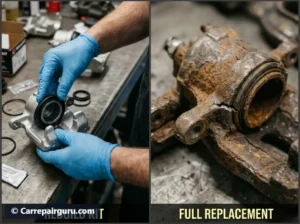
A faulty brake caliper does not always require complete replacement. In some cases, individual components can be repaired or replaced using a suitable rebuild kit.
The correct option depends on the caliper’s condition, the availability of parts, and the vehicle manufacturer’s repair recommendations.
When Rebuilding a Brake Caliper Makes Sense
A rebuild may be suitable when the caliper housing is still in good condition but certain internal or external components have deteriorated.
Depending on the design, a rebuild kit may include:
- Replacement piston seals.
- New dust boots.
- Replacement pistons.
- Guide pins and rubber bushings.
- Other model-specific hardware.
For example, damaged dust boots or worn seals may be repairable if the piston and caliper bore are still within acceptable condition.
However, rebuilding a caliper requires the correct parts, tools, cleaning procedures, and technical knowledge. Brake hydraulic components must be assembled correctly to prevent leaks and braking problems.
When Replacing the Entire Brake Caliper Is Better
Complete replacement is generally the better option when the caliper has serious damage that cannot be repaired reliably.
Replacement may be necessary when:
- The caliper housing is cracked or damaged.
- The piston or caliper bore has severe corrosion or scoring.
- The bleeder valve is badly damaged or cannot be serviced.
- The caliper has persistent leakage.
- Suitable rebuild parts are unavailable.
- The manufacturer specifies replacement rather than rebuilding.
A qualified technician should inspect the caliper before deciding which option is appropriate.
Should You Replace One Brake Caliper or Both?
It is not always necessary to replace both calipers when only one has failed.
If one caliper is damaged and the other is in good condition, replacing the faulty unit may be appropriate, provided the replacement is compatible and the complete braking system is inspected.
However, replacing both calipers on the same axle may be worth considering when they are similarly aged, heavily corroded, or showing signs of deterioration.
The decision should depend on their actual condition, the vehicle manufacturer’s recommendations, and whether the repair will maintain balanced braking performance.
How Much Does Brake Caliper Replacement Cost?
The cost of replacing a brake caliper varies considerably depending on the vehicle, caliper design, replacement part, and labor required.
A basic floating caliper for an everyday passenger car will generally cost less than a multi-piston fixed caliper used on a performance vehicle.
Before estimating the total cost, consider the following factors.
Brake Caliper Parts Cost
The replacement part is usually the largest variable.
Prices depend on:
- Vehicle make, model, and year.
- Front or rear caliper position.
- Floating or fixed caliper design.
- Number of pistons.
- Original equipment or aftermarket part.
- New, remanufactured, or rebuilt condition.
Some replacement calipers are sold as complete assemblies with certain hardware included. Others require additional components to be purchased separately.
Labor Cost
Labor depends on how difficult the caliper is to access and replace.
A straightforward replacement may take less time than a job involving heavily corroded mounting bolts, seized brake hoses, or damaged fittings.
Vehicles with electronic parking brakes or more complex braking systems may also require additional procedures or diagnostic equipment.
Additional Costs to Consider
Replacing a caliper may involve other work if related components are worn or damaged.
Possible additional costs include:
- Brake fluid replacement or bleeding.
- New brake pads, if necessary.
- Brake rotor replacement, if damaged or excessively worn.
- Replacement mounting hardware.
- Repair of a damaged brake hose or fitting.
- Electronic parking brake service procedures, when applicable.
You should also ask whether the replacement caliper is supplied with the required brackets, pins, and hardware.
Practical tip: Ask for an itemized estimate that separates the caliper price, labor, brake fluid, and any additional parts. This makes it easier to compare repair quotes and understand what the job actually includes.
Can You Replace a Brake Caliper Yourself?
Replacing a brake caliper is possible for an experienced home mechanic with the correct tools and vehicle-specific repair information.
However, this is not a routine cosmetic repair. The caliper is part of the hydraulic braking system, and incorrect installation can lead to fluid leaks, air in the brake lines, or brake failure.
Before attempting the job, make sure you understand the procedure for your specific vehicle.
Tools and Equipment Needed
Depending on the vehicle and caliper design, the job may require:
- Vehicle jack and correctly rated jack stands.
- Wheel removal tools.
- Appropriate socket and wrench set.
- Brake line or flare-nut wrench.
- Correct brake fluid.
- Brake bleeding equipment.
- Caliper piston tool, if required.
- Torque wrench.
- Replacement caliper and compatible hardware.
- Vehicle-specific service information.
The exact tools and replacement parts vary by vehicle.
Basic Brake Caliper Replacement Process
The general process involves several steps:
1. Confirm the correct replacement caliper
Check that the replacement matches the vehicle’s make, model, year, engine, and brake configuration. Left and right calipers may differ.
2. Secure the vehicle
Park on a firm, level surface, apply the parking brake when appropriate, and support the vehicle using the correct lifting points and properly rated equipment.
Never work under a vehicle supported only by a jack.
3. Remove the wheel and inspect the brake assembly
Once the wheel is removed, inspect the caliper, brake pads, rotor, mounting hardware, and brake hose for visible damage.
4. Disconnect and remove the old caliper
Follow the vehicle-specific procedure for disconnecting the hydraulic connection and removing the mounting hardware. Avoid twisting, stretching, or damaging the brake hose.
5. Install the replacement caliper
Position the correct replacement caliper and install the required hardware using the manufacturer’s tightening specifications.
6. Reconnect the brake hose and bleed the system
The hydraulic connection must be properly sealed. Air introduced into the system must be removed using the correct bleeding procedure.
Some vehicles require additional procedures involving ABS equipment or electronic controls.
7. Check the completed repair
Inspect for fluid leaks, confirm the brake pedal feels correct, and verify that the braking system operates properly before returning the vehicle to normal use.
The manufacturer’s service information must always take priority over generic instructions. For additional technical guidance, see Brembo’s brake component fitting instructions.
If you do not have the correct equipment or experience with hydraulic brake repairs, have a qualified technician perform the work.
What Is an Electronic Parking Brake (EPB) Caliper?
Some modern vehicles use an electronic parking brake instead of a conventional handbrake lever or foot-operated parking brake.
In certain designs, an electric motor and actuator are integrated into the rear brake caliper. When the parking brake is activated, the system operates the caliper mechanism to hold the vehicle stationary.
This design can change how the caliper must be serviced.
For example, some vehicles require the electronic parking brake to be placed into a special service mode before the rear caliper piston can be retracted.
Trying to force the piston back without following the correct procedure may damage the actuator or other components.
The exact process depends on the vehicle. Some systems use a scan tool, while others have manufacturer-specific manual procedures.
If your vehicle has an electronic parking brake, check the manufacturer’s instructions before replacing the rear calipers or brake pads.
How Can You Make Brake Calipers Last Longer?
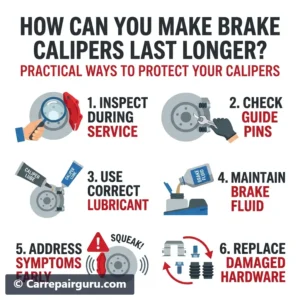
Brake calipers do not usually require replacement at fixed mileage intervals. Their lifespan depends on driving conditions, climate, maintenance, and the quality of the components.
However, regular brake inspections can help identify problems before they cause more serious damage.
Here are some practical ways to protect your calipers.
- Inspect the calipers during brake service: Look for visible fluid leaks, corrosion, damaged dust boots, and unusual wear.
- Check the guide pins: Floating calipers need guide pins that move freely. Have them inspected and serviced with the correct lubricant when necessary.
- Use the correct lubricant: Only use products approved for the specific caliper components. Ordinary grease or petroleum-based products can damage rubber parts.
- Maintain the brake fluid: Follow the manufacturer’s recommended replacement interval and use the specified fluid.
- Address unusual brake symptoms early: Pulling, dragging, excessive heat, and uneven pad wear should be investigated rather than ignored.
- Replace damaged hardware: Worn clips, boots, and guide-pin components can affect caliper operation.
Regular inspections cannot prevent every failure, but they can help catch deterioration before it affects braking performance.
Final Thoughts on Brake Calipers
Brake calipers play a major role in how your vehicle slows down and stops. They use hydraulic pressure to push the brake pads against the rotors, creating the friction needed for controlled braking.
Floating and fixed calipers perform the same basic job, but their designs and maintenance requirements differ. Problems such as seized pistons, corroded guide pins, damaged seals, and torn dust boots can interfere with normal operation.
If you notice uneven pad wear, fluid leaks, excessive heat, or a vehicle that pulls during braking, have the braking system inspected. Depending on the damage, the caliper may be repairable or may need complete replacement.
Because calipers are safety-critical components, any repair should follow the vehicle manufacturer’s specifications and be checked carefully before the vehicle returns to the road.
Frequently Asked Questions
How long do brake calipers usually last?
Brake calipers can last for many years, and some remain in service for the life of a vehicle. Their lifespan depends on corrosion, climate, driving conditions, maintenance, and component quality. There is no universal replacement mileage.
Can you drive with a bad brake caliper?
Driving with a faulty brake caliper is unsafe. A sticking or leaking caliper can cause uneven braking, overheating, reduced stopping performance, or brake fluid loss. Have the vehicle inspected before driving it again.
Is it safe to drive with a sticking brake caliper?
No. A sticking caliper can keep the brake pads pressed against the rotor, creating excessive heat and accelerating brake wear. If you notice a burning smell, smoke, or unusual heat near a wheel, stop somewhere safe and arrange professional assistance.
Can a brake caliper cause uneven brake pad wear?
Yes. A sticking piston or seized guide pins can prevent the caliper from applying or releasing pressure correctly. This may cause one pad to wear faster than the other.
Should brake calipers be replaced in pairs?
Not always. A single faulty caliper can sometimes be replaced on its own if the other caliper is in good condition. However, replacing both on the same axle may be appropriate when both show similar deterioration. Follow the manufacturer’s recommendations and have braking performance checked after the repair.
Can a brake caliper be repaired instead of replaced?
Yes, in some cases. A caliper may be rebuilt using suitable replacement seals, dust boots, pistons, or guide-pin components. However, severe corrosion, damaged bores, cracks, or persistent leakage may make complete replacement the safer option.
Do brake calipers need to be lubricated?
Certain caliper components, such as guide pins and specified sliding surfaces, require suitable lubrication. The piston, brake pads, and rotor friction surfaces must not be lubricated. Always use the lubricant recommended for the specific components.
How much does it cost to replace a brake caliper?
The cost depends on the vehicle, caliper design, replacement part, and labor. Additional expenses may include brake fluid, bleeding, mounting hardware, pads, or rotors. Ask for a vehicle-specific estimate before approving the repair.
About the Author